Skip to content
doubtly

2 answers

Best answer

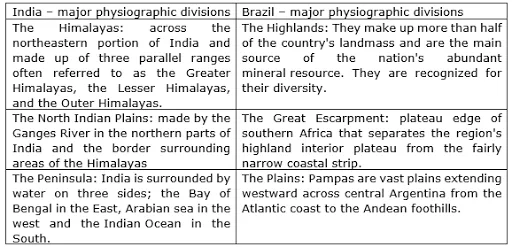
Answer: Brazil is mainly a land of an ancient plateau and lowland plains with no high fold mountains, whereas India has the young fold Himalayas, vast alluvial plains, an old plateau, coastal plains and islands.

BrazilIndia
Most of Brazil is covered by the Brazilian Highlands, an ancient plateau.The Peninsular (Deccan) plateau, also ancient, covers the southern part.
There are no high fold mountains; the Guiana Highlands lie in the north.The Himalayas, young and very high fold mountains, lie in the north.
The steep eastern edge of the plateau is the Great Escarpment, close to the coast.The Western and Eastern Ghats form the edges of the plateau.
The Amazon basin forms a vast lowland plain in the north.The North Indian Plains, formed by the Indus, Ganga and Brahmaputra, lie between the Himalayas and the plateau.
Narrow coastal plains lie along the Atlantic coast on the east.Coastal plains lie on both the west (Arabian Sea) and east (Bay of Bengal).
The Pantanal is a large swampy lowland in the south-west.The Thar Desert lies in the north-west.
Brazil has very few islands.India has island groups: Andaman and Nicobar, and Lakshadweep.

Doubtly · 21 Jun 2021 Report
Was this answer helpful?

Brazil is mainly a land of highlands (plateau) with no very high fold mountains, while India has the lofty Himalayas in the north, the vast North Indian Plains, and the Peninsular Plateau in the south.

BrazilIndia
Physiographic divisions: Brazilian Highlands (plateau), the Great Escarpment, coastal region, plains (Amazon basin and Parana-Paraguay plains), and islands.Physiographic divisions: the Himalayas, the North Indian Plains, the Peninsular Plateau, coastal plains, and islands.
Most of the country is covered by the ancient Brazilian Highlands.The Peninsular Plateau is the ancient landmass; the north is occupied by young fold mountains and plains.
There are no high fold mountains; the highest peak, Pico da Neblina, is about 3000 m high.The Himalayas are young fold mountains with very high peaks; Kanchenjunga (8586 m) is the highest peak in India.
The Amazon basin in the north is a low-lying plain covered with dense forests and is sparsely populated.The North Indian Plains, formed by deposits of the Ganga, Brahmaputra and Indus systems, are fertile and densely populated.
The Great Escarpment forms a steep edge along the eastern side of the highlands; the coastal plain is narrow.The Western and Eastern Ghats form the edges of the plateau; the western coastal plain is narrow and the eastern one is wide.
Has a large wetland region, the Pantanal.Has a desert region, the Thar Desert, in the north-west.
Doubtly AI · 23 Oct 2026 AI-verified · Oct 2026 Report
Was this answer helpful?

Your answer

Log in or create a free account to answer this question.