
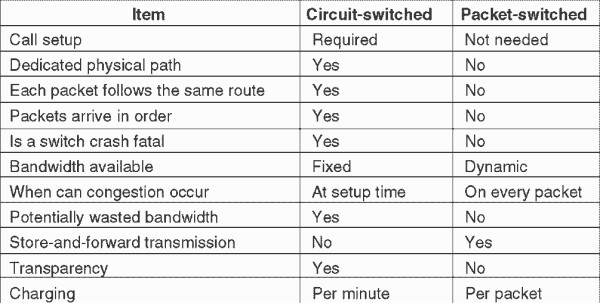
A comparison of circuit switched and packet-switched networks
Best answer
A comparison of circuit switched and packet-switched networks
Answer: In circuit switching a dedicated path is set up between sender and receiver before any data flows. In packet switching data is split into packets that share the links and are forwarded independently, with no dedicated path.
| Point | Circuit switching | Packet switching |
|---|---|---|
| Path | Dedicated end-to-end path set up first (call set-up) | No dedicated path; each packet is routed hop by hop |
| Phases | Set-up, data transfer, tear-down | No set-up needed (datagram); packets sent directly |
| Resource use | Bandwidth reserved for the whole call, wasted when idle | Bandwidth shared on demand, used efficiently |
| Delay | Set-up delay, then small and constant | Variable delay due to queuing at routers |
| Order of data | Always arrives in order | Packets may arrive out of order and are reordered at the receiver |
| Store-and-forward | Not used | Used at every router |
| Congestion | Shows up at set-up: the call is blocked | Shows up during transfer: delay or packet loss |
| Link failure | Connection is broken | Packets can be rerouted |
| Charging | By time and distance | By volume of data |
| Example | Traditional telephone network (PSTN) | The Internet (IP networks) |
Similarities: both carry data across a network of switching nodes, and both must deliver it from source to destination over shared physical links.
In short: circuit switching suits steady, real-time traffic such as voice calls, while packet switching suits bursty data traffic and makes better use of the network.
Log in or create a free account to answer this question.