Chapter: Mechanical Properties of Fluids· Physics
Answer: Work done \(W = 2.19\times10^{-5}\ \text{J}\) (219 erg)
Given: \(R = 0.2\ \text{cm}\), \(n = 8\), \(T = 435.5\ \text{dyne/cm}\)
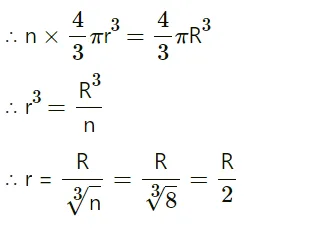
Step 1: Radius of each droplet
Volume is conserved: \(\tfrac43\pi R^3 = n\cdot\tfrac43\pi r^3\)
\(r = \dfrac{R}{n^{1/3}} = \dfrac{0.2}{8^{1/3}} = \dfrac{0.2}{2} = 0.1\ \text{cm}\)
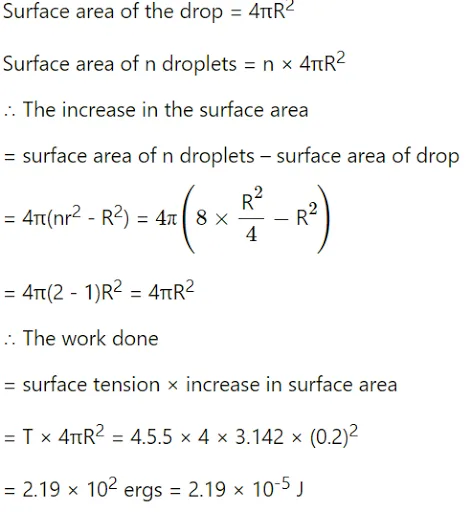
Step 2: Increase in surface area
\(\Delta A = n(4\pi r^2) - 4\pi R^2 = 4\pi(8\times0.1^2 - 0.2^2)\)
\(= 4\pi(0.08 - 0.04) = 4\pi\times0.04 = 0.5027\ \text{cm}^2\)
Step 3: Work done
\(W = T\Delta A = 435.5\times0.5027 = 218.9\ \text{erg}\)
\(= 218.9\times10^{-7}\ \text{J} \approx 2.19\times10^{-5}\ \text{J}\)