Chapter: COMPLEX NUMBERS AND QUADRATIC EQUATIONS· Mathematics
If the equation a|z|^2 + bar (bar α z + α bar z) + d = 0 represents a circle
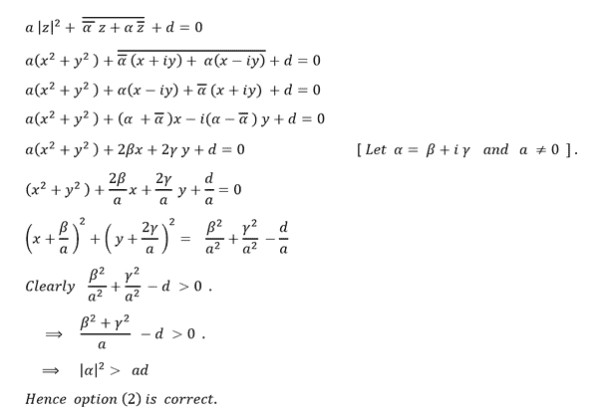
If the equation a|z|2 + \(\overline{\overline\alpha z+\alpha\overline z}\) + d = 0 represents a circle where a, d are real constants then which of the following condition is correct ?
(1) |α|2- ad ≠ 0
(2) |α|2 - ad > 0 and a ∈ R - {0}
(3) |α|2 - ad ≥ 0 and a ∈ R
(4) α = 0, a, d∈ R+