
Topic: Logic gates (OR, AND, NOT, NAND, NOR)· Electronic Devices
To get output 1 for the following circuit, the correct choice for the input is :
To get output 1 for the following circuit, the correct choice for the input is :
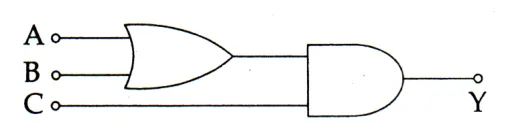
1. A = 0, B = 1, C = 0
2. A = 1, B = 0, C = 0
3. A = 1, B = 1, C = 0
4. A = 1, B = 0, C = 1