Skip to content
doubtly
Topic: Phenols: acidity, electrophilic substitution, Reimer-Tiemann· Organic Compounds Containing Oxygen

In the reaction[phenol + CHCl_3 + NaOH → sodium salicylaldehyde (o-O^-Na^+ C_6H_4 CHO), shown as a structure]the electrophile involved is

In the reaction

[phenol + CHCl\(_3\) + NaOH \(\rightarrow\) sodium salicylaldehyde (o-O\(^-\)Na\(^+\) C\(_6\)H\(_4\) CHO), shown as a structure]

the electrophile involved is
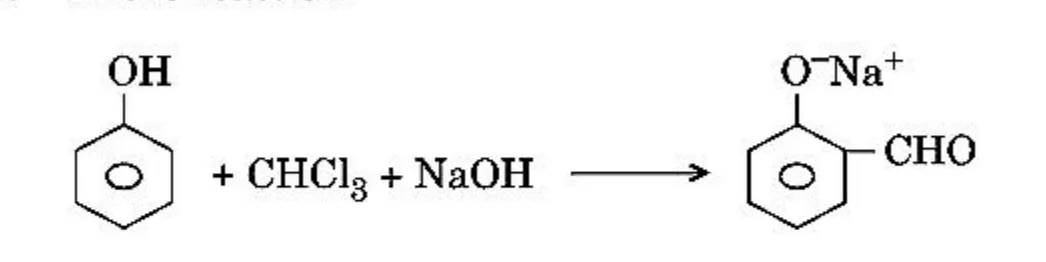
reaction of phenol with CHCl3 and NaOH giving sodium salicylaldehyde

1. dichloromethyl cation (\(\overset{\oplus}{C}\)HCl\(_2\))

2. dichloromethyl anion (\(\overset{\ominus}{C}\)HCl\(_2\))

3. formyl cation (\(\overset{\oplus}{C}\)HO)

4. dichlorocarbene (:CCl\(_2\))

1 answer

Best answer

Answer: 4. dichlorocarbene (:CCl\(_2\))

This is the Reimer-Tiemann reaction. The electrophile is dichlorocarbene.

The base removes a proton from \(\mathrm{CHCl_3}\) to give \(\mathrm{{}^-CCl_3}\), which loses \(\mathrm{Cl^-}\) to form the neutral, electron-deficient \(\mathrm{:CCl_2}\). It attacks the electron-rich phenoxide ring at the ortho position, and the product hydrolyses to the -CHO group.

Doubtly AI · 30 Oct 2026 AI-generated · not yet verified Report
Was this answer helpful?

Your answer

Log in or create a free account to answer this question.