Skip to content
doubtly
Topic: EMF, Nernst equation and applications· Redox Reactions and Electrochemistry

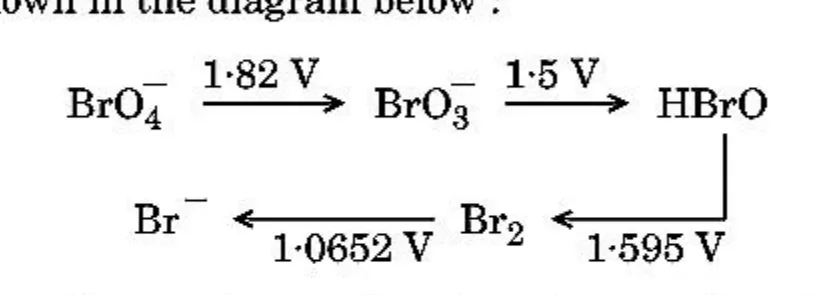
Consider the change in oxidation state of Bromine corresponding to different emf values as shown in the diagram below :BrO_4^- 1.82\ V BrO_3^- 1.5\ V HBrO 1.595\ V Br_2 1.0652\ V Br^-Then the species undergoing disproportionation is

Consider the change in oxidation state of Bromine corresponding to different emf values as shown in the diagram below :

BrO\(_4^-\) \(\xrightarrow{1.82\ V}\) BrO\(_3^-\) \(\xrightarrow{1.5\ V}\) HBrO \(\xrightarrow{1.595\ V}\) Br\(_2\) \(\xrightarrow{1.0652\ V}\) Br\(^-\)

Then the species undergoing disproportionation is
bromine oxidation state emf diagram

1. BrO\(_3^-\)

2. Br\(_2\)

3. BrO\(_4^-\)

4. HBrO

1 answer

Best answer

Answer: 4. HBrO

A species disproportionates if the emf for its reduction (to the species on one side) is higher than the emf for its oxidation, i.e. when \(E^\circ_{\text{right}}>E^\circ_{\text{left}}\) around it.

For HBrO: on its right (reduction to \(\mathrm{Br_2}\)) \(E^\circ=1.595\) V; on its left (\(\mathrm{BrO_3^-}\to\mathrm{HBrO}\)) \(E^\circ=1.5\) V. Since 1.595 > 1.5, HBrO is both reduced and oxidised spontaneously, so it disproportionates. The same test fails for \(\mathrm{BrO_3^-}\) (1.5 < 1.82) and \(\mathrm{Br_2}\) (1.0652 < 1.595).

Doubtly AI · 30 Oct 2026 AI-generated · not yet verified Report
Was this answer helpful?

Your answer

Log in or create a free account to answer this question.