
Topic: Force on moving charge in magnetic and electric fields· Magnetic Effects of Current and Magnetism
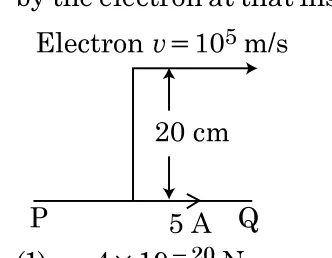
An infinitely long straight conductor carries a current of 5 A as shown. An electron is moving with a speed of 10^5 m/s parallel to the conductor. The perpendicular distance between the electron and the conductor is 20 cm at an instant. Calculate the…
An infinitely long straight conductor carries a current of 5 A as shown. An electron is moving with a speed of \(10^5\) m/s parallel to the conductor. The perpendicular distance between the electron and the conductor is 20 cm at an instant. Calculate the magnitude of the force experienced by the electron at that instant.
1. \(4\times10^{-20}\) N
2. \(8\pi\times10^{-20}\) N
3. \(4\pi\times10^{-20}\) N
4. \(8\times10^{-20}\) N