
Topic: Reactance, impedance, LCR series circuit, resonance· Electromagnetic Induction and Alternating Currents
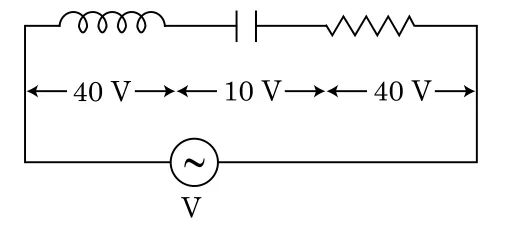
An inductor of inductance L, a capacitor of capacitance C and a resistor of resistance 'R' are connected in series to an ac source of potential difference 'V' volts as shown in figure.Potential difference across L, C and R is 40 V, 10 V and 40 V, res…
An inductor of inductance L, a capacitor of capacitance C and a resistor of resistance 'R' are connected in series to an ac source of potential difference 'V' volts as shown in figure.
Potential difference across L, C and R is 40 V, 10 V and 40 V, respectively. The amplitude of current flowing through LCR series circuit is \(10\sqrt{2}\) A. The impedance of the circuit is :
1. \(4\sqrt{2}\ \Omega\)
2. \(5/\sqrt{2}\ \Omega\)
3. \(4\ \Omega\)
4. \(5\ \Omega\)