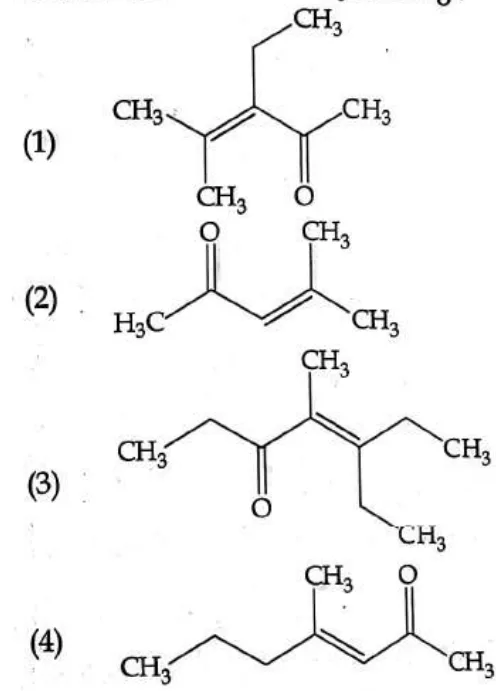
Correct option: (3)
Key idea: with dilute NaOH and heat, each ketone can form an enolate (from any \(\alpha\)-carbon) and attack the C=O of either ketone; the aldol then loses water to give an \(\alpha,\beta\)-unsaturated ketone. Self and crossed products are both possible.
- Option (2), \(\mathrm{(CH_3)_2C{=}CHCOCH_3}\) (mesityl oxide): acetone enolate + acetone. Formed.
- Option (1), \(\mathrm{(CH_3)_2C{=}C(C_2H_5)COCH_3}\): enolate from C-3 of 2-pentanone attacks acetone. Formed.
- Option (4), \(\mathrm{CH_3CH_2CH_2C(CH_3){=}CHCOCH_3}\): acetone enolate attacks 2-pentanone. Formed.
- Option (3), \(\mathrm{CH_3CH_2CO{-}C(CH_3){=}C(C_2H_5)_2}\): the carbon \(\mathrm{=C(C_2H_5)_2}\) would have to come from the C=O of 3-pentanone \(\mathrm{(C_2H_5)_2CO}\), and the part \(\mathrm{C_2H_5CO{-}CH(CH_3){-}}\) from an enolate of 3-pentanone too. Neither acetone nor 2-pentanone (\(\mathrm{CH_3COCH_2CH_2CH_3}\)) has a carbonyl carbon carrying two ethyl groups, so this product cannot form.
Note: 2-pentanone can self-condense to give 10-carbon products, but those carry a methyl and a propyl group on the C=C carbon, not two ethyls. Answer: option (3).