Skip to content
doubtly
Topic: Magnification, power of lens, combination of thin lenses· Optics

In the figure shown here, what is the equivalent focal length of the combination of lenses (Assume that all layers are thin)?
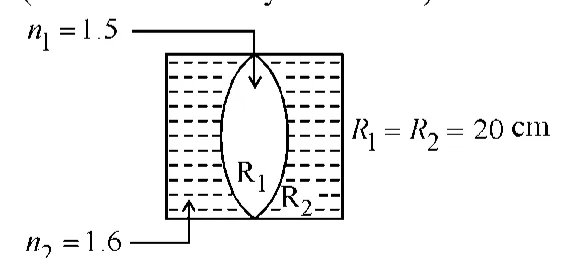
In the figure shown here, what is the equivalent focal length of the combination of lenses (Assume that all layers are thin)?

biconvex lens R1=R2=20 cm between media n1=1.5 (above) and n2=1.6 (below)

1. \(-50\) cm

2. 40 cm

3. \(-40\) cm

4. \(-100\) cm

1 answer

Best answer

Answer: 4. \(-100\) cm

Add the powers of the two refracting surfaces of the lens (\(n=1.5\)) placed in a medium of index \(1.6\), using \(P=\dfrac{n_2-n_1}{R}\).

  1. Surface 1: \(P_1=\dfrac{1.5-1.6}{0.20}=-0.5\) D.
  2. Surface 2: \(P_2=\dfrac{1.6-1.5}{-0.20}=-0.5\) D.
  3. \(P=-1\) D, and taking \(f=1/P\) gives \(f=-1\) m \(=-100\) cm.

A biconvex lens of lower index than its surroundings acts as a diverging lens, so the sign is negative. The answer is \(-100\) cm.

Doubtly AI · 30 Oct 2026 AI-generated · not yet verified Report
Was this answer helpful?

Your answer

Log in or create a free account to answer this question.