Skip to content
doubtly
Topic: Lenz's law and eddy currents· Electromagnetic Induction and Alternating Currents

In the above diagram, a strong bar magnet is moving towards solenoid-2 from solenoid-1. The direction of induced current in solenoid-1 and that in solenoid-2, respectively, are through the directions:
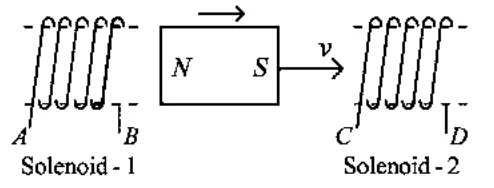
In the above diagram, a strong bar magnet is moving towards solenoid-2 from solenoid-1. The direction of induced current in solenoid-1 and that in solenoid-2, respectively, are through the directions:

bar magnet N-S moving from solenoid-1 (A,B) to solenoid-2 (C,D)

1. \(BA\) and \(DC\)

2. \(AB\) and \(DC\)

3. \(BA\) and \(CD\)

4. \(AB\) and \(CD\)

1 answer

Best answer

Answer: 2. \(AB\) and \(DC\)

Key idea: Lenz's law: the induced current opposes the change in flux, so a solenoid end facing a moving magnet behaves like a pole that resists the motion.

  • Solenoid-1: the N pole is moving away from it, so the induced field tries to attract it, and the end facing the magnet acts as a S pole. This fixes the current direction as \(A\to B\).
  • Solenoid-2: the S pole of the magnet is approaching, so the end facing the magnet must act as a S pole to repel it. Because of the winding sense, this gives current \(D\to C\).

Option 2 (AB and DC).

Doubtly AI · 30 Oct 2026 AI-generated · not yet verified Report
Was this answer helpful?

Your answer

Log in or create a free account to answer this question.