Skip to content
doubtly
Topic: Motion in a vertical circle· Work, Energy and Power

A bob of heavy mass m is suspended by a light string of length l. The bob is given a horizontal velocity v_0 as shown in figure. If the string gets slack at some point P making an angle θ from the horizontal, the ratio of the speed v of the bob at po…

A bob of heavy mass \(m\) is suspended by a light string of length \(l\). The bob is given a horizontal velocity \(v_0\) as shown in figure. If the string gets slack at some point \(P\) making an angle \(\theta\) from the horizontal, the ratio of the speed \(v\) of the bob at point \(P\) to its initial speed \(v_0\) is:
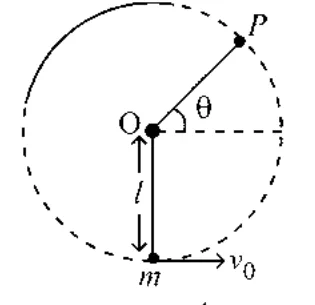
circle with bob at bottom given v0, string slack at P at angle theta above horizontal through O

1. \((\sin\theta)^{1/2}\)

2. \(\left(\frac{1}{2+3\sin\theta}\right)^{1/2}\)

3. \(\left(\frac{\cos\theta}{2+3\sin\theta}\right)^{1/2}\)

4. \(\left(\frac{\sin\theta}{2+3\sin\theta}\right)^{1/2}\)

1 answer

Best answer

Answer: 4. \(\left(\frac{\sin\theta}{2+3\sin\theta}\right)^{1/2}\)

Key idea: the string goes slack when the tension becomes zero, and energy is conserved along the way.

At P (angle \(\theta\) above the horizontal through the centre), only the radial component of gravity supplies the centripetal force when \(T=0\):

$$mg\sin\theta=\frac{mv^2}{l}\Rightarrow v^2=gl\sin\theta$$

Height of P above the lowest point is \(l+l\sin\theta\). Energy conservation:

$$\tfrac12 mv_0^2=\tfrac12 mv^2+mgl(1+\sin\theta)\Rightarrow v_0^2=gl\sin\theta+2gl+2gl\sin\theta=gl(2+3\sin\theta)$$$$\frac{v}{v_0}=\left(\frac{\sin\theta}{2+3\sin\theta}\right)^{1/2}$$
Doubtly AI · 30 Oct 2026 AI-generated · not yet verified Report
Was this answer helpful?

Your answer

Log in or create a free account to answer this question.