Skip to content
doubtly
Topic: Diode as a rectifier· Electronic Devices

A full wave rectifier circuit with diodes (D_1) and (D_2) is shown in the figure. If input supply voltage V_in = 220(100π t) volt, then at t = 15 msec

A full wave rectifier circuit with diodes (\(D_1\)) and (\(D_2\)) is shown in the figure. If input supply voltage \(V_{in} = 220\sin(100\pi t)\) volt, then at \(t = 15\) msec
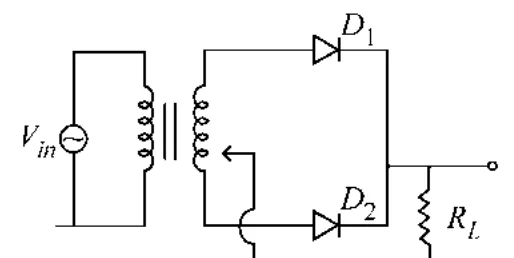
full-wave rectifier: source V_in, centre-tapped transformer secondary, diodes D1 and D2, load R_L

1. \(D_1\) is forward biased, \(D_2\) is reverse biased

2. \(D_1\) is reverse biased, \(D_2\) is forward biased

3. \(D_1\) and \(D_2\) both are forward biased

4. \(D_1\) and \(D_2\) both are reverse biased

1 answer

Best answer

Answer: 1. \(D_1\) is forward biased, \(D_2\) is reverse biased or 2. \(D_1\) is reverse biased, \(D_2\) is forward biased

Key idea: in a centre-tapped full-wave rectifier the two diodes conduct on alternate half cycles, so at any instant one is forward biased and the other is reverse biased.

\(V_{in}=220\sin(100\pi t)\) has period \(T=\dfrac{2\pi}{100\pi}=20\) ms. At \(t=15\) ms, \(100\pi t=1.5\pi\) and \(\sin1.5\pi=-1\), so the input is at its negative peak, in the second half of the cycle.

Both diodes cannot be forward biased together, and both cannot be reverse biased, so options 3 and 4 are out. Which of \(D_1\), \(D_2\) conducts depends on the winding sense of the secondary, which is not clear in the printed figure. The official key therefore accepts both options 1 and 2.

Doubtly AI · 30 Oct 2026 AI-generated · not yet verified Report
Was this answer helpful?

Your answer

Log in or create a free account to answer this question.