Skip to content
doubtly
Topic: Excretion: modes, nephron, urine formation, osmoregulation· Human Physiology

Which of the following diagrams is correct with regard to the proximal (P) and distal (D) tubule of the Nephron.
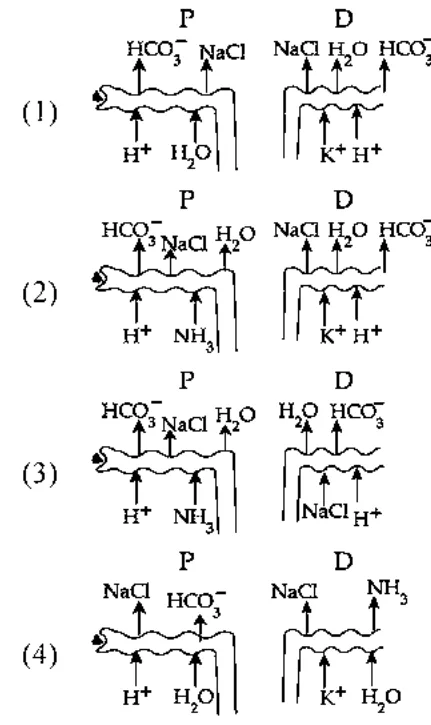
Which of the following diagrams is correct with regard to the proximal (P) and distal (D) tubule of the Nephron.

Four nephron proximal/distal tubule diagrams (the answer options) showing ion transport arrows

1. Diagram option (1): P: HCO3-, NaCl out; H+, H2O in. D: NaCl, H2O, HCO3- out; K+, H+ in

2. Diagram option (2): P: HCO3-, NaCl, H2O out; H+, NH3 in. D: NaCl, H2O, HCO3- out; K+, H+ in

3. Diagram option (3): P: HCO3-, NaCl, H2O out; H+, NH3 in. D: H2O, HCO3- out; NaCl, H+ in

4. Diagram option (4): P: NaCl, HCO3- out; H+, H2O in. D: NaCl, NH3 out; K+, H2O in

1 answer

Best answer

Answer: 2. Diagram option (2): P: HCO3-, NaCl, H2O out; H+, NH3 in. D: NaCl, H2O, HCO3- out; K+, H+ in

Key idea: The proximal tubule reabsorbs most substances and secretes some, while the distal tubule does conditional reabsorption and secretion.

In the proximal tubule, \(\mathrm{HCO_3^-}\), NaCl and water are reabsorbed, while \(\mathrm{H^+}\) and \(\mathrm{NH_3}\) are secreted. In the distal tubule, NaCl, water and \(\mathrm{HCO_3^-}\) are reabsorbed, while \(\mathrm{K^+}\) and \(\mathrm{H^+}\) are secreted. This matches diagram (2).

Other diagrams show water moving into the proximal tubule, or wrong ions in the distal tubule.

Doubtly AI · 30 Oct 2026 AI-generated · not yet verified Report
Was this answer helpful?

Your answer

Log in or create a free account to answer this question.