
find laplace transform of the following question

Best answer
The Laplace transform of a function \(f(t)\) is defined as \(\mathcal{L}\{f(t)\} = F(s) = \int_{0}^{\infty} e^{-st} f(t) \, dt\), provided the integral converges.
Since the specific function was not provided in the question, standard formulas and properties for common functions are summarized below.
Constant \(1\): \[ \mathcal{L}\{1\} = \frac{1}{s}, \quad \text{for } s > 0 \]
Exponential function \(e^{at}\): \[ \mathcal{L}\{e^{at}\} = \frac{1}{s - a}, \quad \text{for } s > a \]
Power function \(t^n\) (where \(n\) is a non-negative integer): \[ \mathcal{L}\{t^n\} = \frac{n!}{s^{n+1}}, \quad \text{for } s > 0 \]
Sine function \(\sin(at)\): \[ \mathcal{L}\{\sin(at)\} = \frac{a}{s^2 + a^2}, \quad \text{for } s > 0 \]
Cosine function \(\cos(at)\): \[ \mathcal{L}\{\cos(at)\} = \frac{s}{s^2 + a^2}, \quad \text{for } s > 0 \]
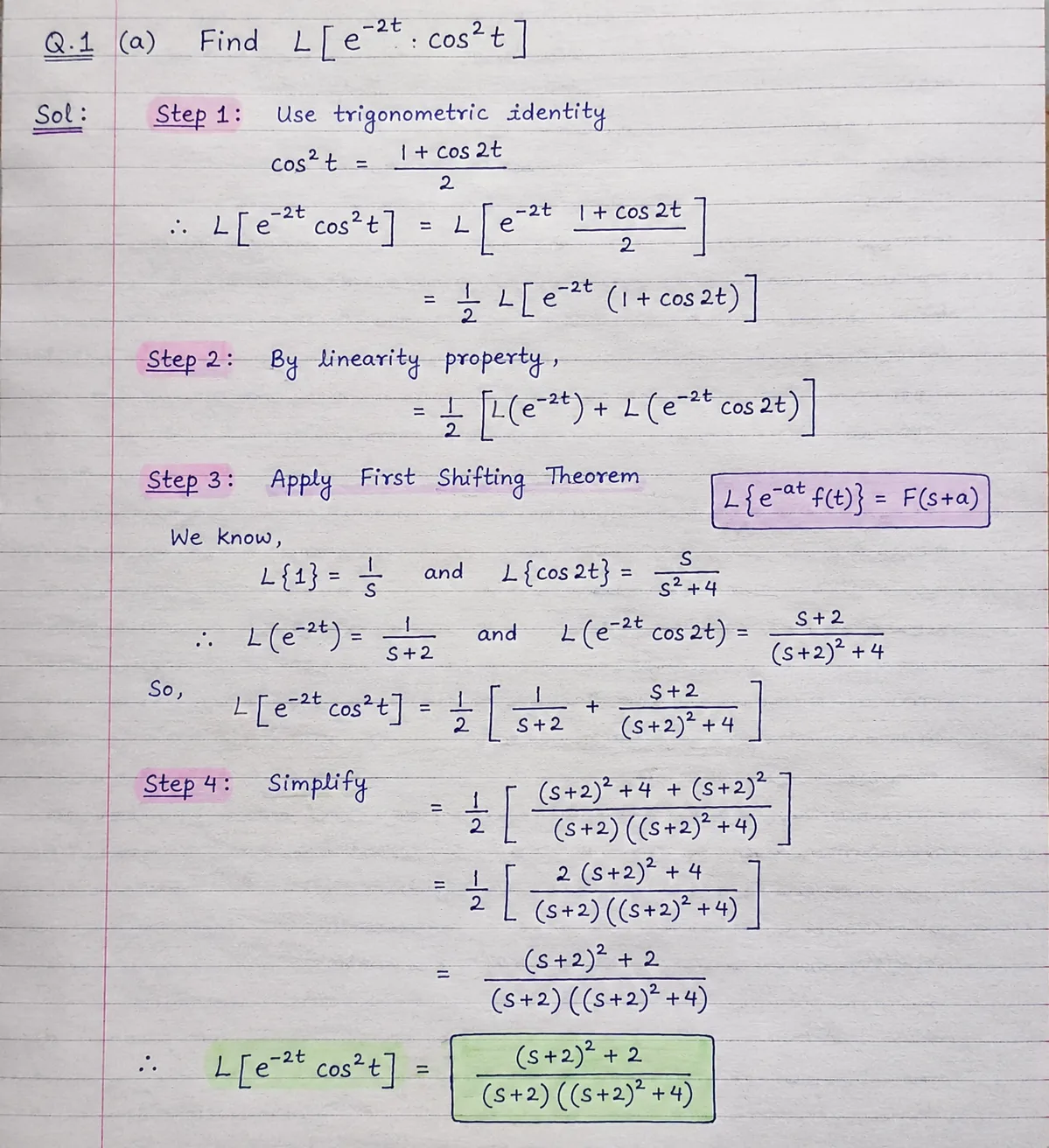
Linearity: \[ \mathcal{L}\{a \cdot f(t) + b \cdot g(t)\} = a \cdot \mathcal{L}\{f(t)\} + b \cdot \mathcal{L}\{g(t)\} \]
First Shifting Theorem: \[ \mathcal{L}\{e^{at} f(t)\} = F(s - a) \]
Log in or create a free account to answer this question.