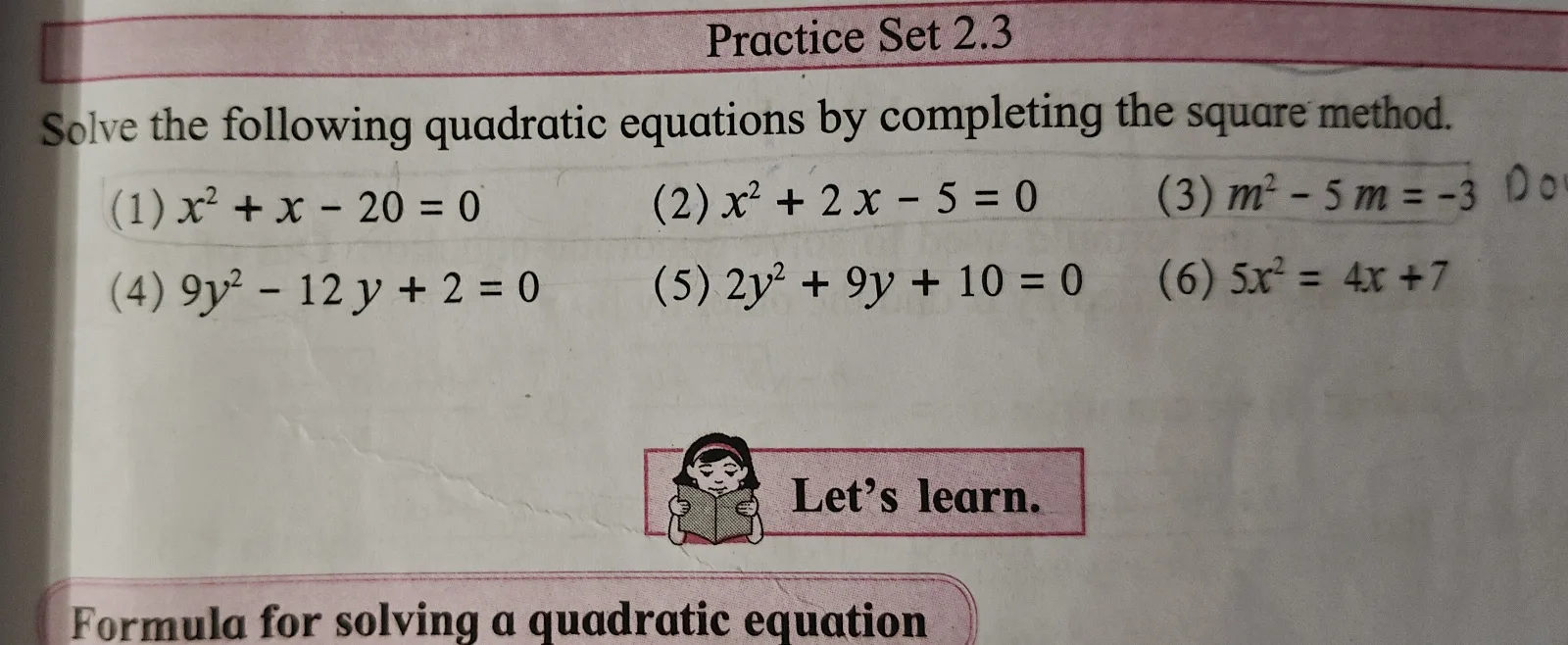
Here are all six equations of Practice Set 2.3, each solved by both methods: completing the square and the formula method. Both methods always give the same roots, which is a good way to check your answer.
Completing the square, the steps: make the coefficient of \(x^2\) equal to 1, keep only the \(x^2\) and \(x\) terms on the left, add \(\left(\dfrac{\text{coefficient of } x}{2}\right)^2\) to both sides, write the left side as a perfect square, then take the square root.
Formula: for \(ax^2 + bx + c = 0\), \(x = \dfrac{-b \pm \sqrt{b^2 - 4ac}}{2a}\).
(1) \(x^2 + x - 20 = 0\)
Method 1: Completing the square
- \(x^2 + x = 20\)
- Add \(\left(\dfrac{1}{2}\right)^2 = \dfrac{1}{4}\) to both sides: \(x^2 + x + \dfrac{1}{4} = 20 + \dfrac{1}{4}\)
- \(\left(x + \dfrac{1}{2}\right)^2 = \dfrac{81}{4}\)
- \(x + \dfrac{1}{2} = \pm \dfrac{9}{2}\)
- \(x = -\dfrac{1}{2} + \dfrac{9}{2} = 4\) or \(x = -\dfrac{1}{2} - \dfrac{9}{2} = -5\)
Method 2: Formula method
- \(a = 1,\ b = 1,\ c = -20\)
- \(b^2 - 4ac = 1 + 80 = 81\)
- \(x = \dfrac{-1 \pm 9}{2}\), so \(x = 4\) or \(x = -5\)
Answer: \(x = 4\) or \(x = -5\)
(2) \(x^2 + 2x - 5 = 0\)
Method 1: Completing the square
- \(x^2 + 2x = 5\)
- Add \(\left(\dfrac{2}{2}\right)^2 = 1\): \(x^2 + 2x + 1 = 6\)
- \((x + 1)^2 = 6\)
- \(x + 1 = \pm \sqrt{6}\)
- \(x = -1 + \sqrt{6}\) or \(x = -1 - \sqrt{6}\)
Method 2: Formula method
- \(a = 1,\ b = 2,\ c = -5\)
- \(b^2 - 4ac = 4 + 20 = 24\), and \(\sqrt{24} = 2\sqrt{6}\)
- \(x = \dfrac{-2 \pm 2\sqrt{6}}{2} = -1 \pm \sqrt{6}\)
Answer: \(x = -1 + \sqrt{6}\) or \(x = -1 - \sqrt{6}\)
(3) \(m^2 - 5m = -3\)
Method 1: Completing the square
- The \(m^2\) and \(m\) terms are already on the left: \(m^2 - 5m = -3\)
- Add \(\left(\dfrac{5}{2}\right)^2 = \dfrac{25}{4}\): \(m^2 - 5m + \dfrac{25}{4} = -3 + \dfrac{25}{4}\)
- \(\left(m - \dfrac{5}{2}\right)^2 = \dfrac{13}{4}\)
- \(m - \dfrac{5}{2} = \pm \dfrac{\sqrt{13}}{2}\)
- \(m = \dfrac{5 + \sqrt{13}}{2}\) or \(m = \dfrac{5 - \sqrt{13}}{2}\)
Method 2: Formula method
- Standard form: \(m^2 - 5m + 3 = 0\), so \(a = 1,\ b = -5,\ c = 3\)
- \(b^2 - 4ac = 25 - 12 = 13\)
- \(m = \dfrac{5 \pm \sqrt{13}}{2}\)
Answer: \(m = \dfrac{5 + \sqrt{13}}{2}\) or \(m = \dfrac{5 - \sqrt{13}}{2}\)
(4) \(9y^2 - 12y + 2 = 0\)
Method 1: Completing the square
- Divide by 9: \(y^2 - \dfrac{4}{3}y + \dfrac{2}{9} = 0\), so \(y^2 - \dfrac{4}{3}y = -\dfrac{2}{9}\)
- Add \(\left(\dfrac{2}{3}\right)^2 = \dfrac{4}{9}\): \(y^2 - \dfrac{4}{3}y + \dfrac{4}{9} = -\dfrac{2}{9} + \dfrac{4}{9}\)
- \(\left(y - \dfrac{2}{3}\right)^2 = \dfrac{2}{9}\)
- \(y - \dfrac{2}{3} = \pm \dfrac{\sqrt{2}}{3}\)
- \(y = \dfrac{2 + \sqrt{2}}{3}\) or \(y = \dfrac{2 - \sqrt{2}}{3}\)
Method 2: Formula method
- \(a = 9,\ b = -12,\ c = 2\)
- \(b^2 - 4ac = 144 - 72 = 72\), and \(\sqrt{72} = 6\sqrt{2}\)
- \(y = \dfrac{12 \pm 6\sqrt{2}}{18} = \dfrac{2 \pm \sqrt{2}}{3}\)
Answer: \(y = \dfrac{2 + \sqrt{2}}{3}\) or \(y = \dfrac{2 - \sqrt{2}}{3}\)
(5) \(2y^2 + 9y + 10 = 0\)
Method 1: Completing the square
- Divide by 2: \(y^2 + \dfrac{9}{2}y + 5 = 0\), so \(y^2 + \dfrac{9}{2}y = -5\)
- Add \(\left(\dfrac{9}{4}\right)^2 = \dfrac{81}{16}\): \(y^2 + \dfrac{9}{2}y + \dfrac{81}{16} = -5 + \dfrac{81}{16}\)
- \(\left(y + \dfrac{9}{4}\right)^2 = \dfrac{1}{16}\)
- \(y + \dfrac{9}{4} = \pm \dfrac{1}{4}\)
- \(y = -\dfrac{9}{4} + \dfrac{1}{4} = -2\) or \(y = -\dfrac{9}{4} - \dfrac{1}{4} = -\dfrac{5}{2}\)
Method 2: Formula method
- \(a = 2,\ b = 9,\ c = 10\)
- \(b^2 - 4ac = 81 - 80 = 1\)
- \(y = \dfrac{-9 \pm 1}{4}\), so \(y = -2\) or \(y = -\dfrac{5}{2}\)
Answer: \(y = -2\) or \(y = -\dfrac{5}{2}\)
(6) \(5x^2 = 4x + 7\)
Method 1: Completing the square
- Standard form: \(5x^2 - 4x - 7 = 0\). Divide by 5: \(x^2 - \dfrac{4}{5}x = \dfrac{7}{5}\)
- Add \(\left(\dfrac{2}{5}\right)^2 = \dfrac{4}{25}\): \(x^2 - \dfrac{4}{5}x + \dfrac{4}{25} = \dfrac{35}{25} + \dfrac{4}{25}\)
- \(\left(x - \dfrac{2}{5}\right)^2 = \dfrac{39}{25}\)
- \(x - \dfrac{2}{5} = \pm \dfrac{\sqrt{39}}{5}\)
- \(x = \dfrac{2 + \sqrt{39}}{5}\) or \(x = \dfrac{2 - \sqrt{39}}{5}\)
Method 2: Formula method
- \(a = 5,\ b = -4,\ c = -7\)
- \(b^2 - 4ac = 16 + 140 = 156\), and \(\sqrt{156} = 2\sqrt{39}\)
- \(x = \dfrac{4 \pm 2\sqrt{39}}{10} = \dfrac{2 \pm \sqrt{39}}{5}\)
Answer: \(x = \dfrac{2 + \sqrt{39}}{5}\) or \(x = \dfrac{2 - \sqrt{39}}{5}\)
Common mistakes: in completing the square, first make the coefficient of the squared term 1 (equations 4, 5 and 6), and add the same number to both sides. In the formula method, write the equation as \(ax^2 + bx + c = 0\) first, so the signs of \(b\) and \(c\) are right (equations 3 and 6).
More solved questions from this chapter: Quadratic Equations.