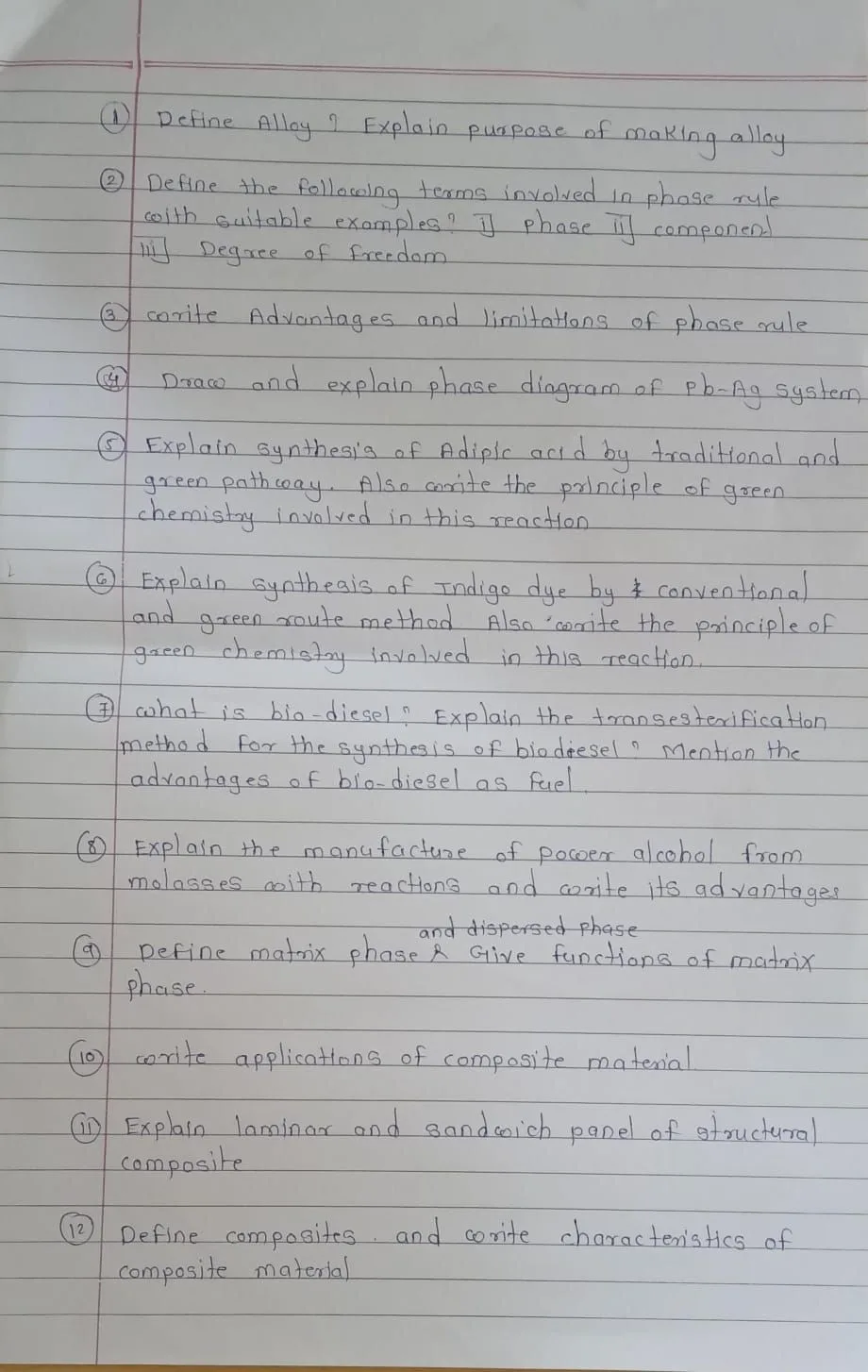
All 12 questions from your sheet, answered in the MU Applied Chemistry (FE Sem 1) pattern. Each answer has a definition, points and examples. For 5-mark questions, write all the points. For 3-mark questions, the definition plus 3–4 points is enough.
Q1. Define alloy. Explain the purpose of making alloys.
Alloy: An alloy is a homogeneous mixture of two or more elements, at least one of which is a metal, made by fusing them together. Examples: brass (Cu + Zn), bronze (Cu + Sn), stainless steel (Fe + Cr + Ni + C).
Purposes of making alloys:
- To increase hardness: pure metals are soft. Example: pure gold is soft, so it is alloyed with copper for jewellery.
- To increase tensile strength: example: steel (Fe + C) is much stronger than pure iron.
- To lower the melting point (fusible alloys): example: Wood's metal (Bi, Pb, Sn, Cd) melts at about 71 °C and is used in safety fuses and fire sprinklers.
- To increase corrosion resistance: example: stainless steel (with Cr and Ni) does not rust.
- To improve castability: pure metals shrink on solidifying and give poor castings. Example: type metal (Pb + Sb + Sn) expands slightly on solidifying and gives sharp castings.
- To change colour: example: brass has a golden colour and is used for decorative articles.
- To change electrical and magnetic properties: example: nichrome (Ni + Cr) has high resistance and is used in heater coils.
Q2. Define the terms of the phase rule with examples: (i) phase, (ii) component, (iii) degree of freedom
Phase rule (Gibbs): F = C − P + 2, where F = degrees of freedom, C = number of components and P = number of phases.
(i) Phase (P)
A phase is a homogeneous, physically distinct and mechanically separable part of a system, separated from the other parts by definite boundaries.
- Water system (ice ⇌ water ⇌ vapour): 3 phases.
- A mixture of gases: 1 phase (gases always mix completely).
- Two miscible liquids (water + alcohol): 1 phase. Two immiscible liquids (water + oil): 2 phases.
- CaCO3(s) ⇌ CaO(s) + CO2(g): 3 phases (each solid is a separate phase).
(ii) Component (C)
The number of components is the smallest number of independently variable chemical constituents by which the composition of every phase can be expressed.
- Water system: C = 1 (every phase is H2O).
- Sulphur system: C = 1.
- CaCO3 ⇌ CaO + CO2: C = 2 (any two of the three fix the third).
- NH4Cl(s) ⇌ NH3(g) + HCl(g): C = 1 when NH3 and HCl are in equal amounts.
(iii) Degree of freedom (F)
The degree of freedom (variance) is the minimum number of independent variables, such as temperature, pressure and concentration, that must be fixed to define the system completely.
- Water at the triple point (ice, water and vapour together): F = 1 − 3 + 2 = 0 (invariant).
- Water ⇌ vapour: F = 1 − 2 + 2 = 1 (univariant: fixing T also fixes P).
- Water vapour alone: F = 1 − 1 + 2 = 2 (bivariant: both T and P must be fixed).
Q3. Write the advantages and limitations of the phase rule
Advantages
- It applies to both physical and chemical equilibria.
- It does not depend on the molecular structure of the substances; only the number of phases and components is needed.
- Different systems with the same F behave in the same way, so systems can be classified (invariant, univariant, bivariant).
- It predicts how a system behaves when temperature, pressure or concentration changes.
- It shows whether substances exist together in equilibrium.
- It is very useful in metallurgy: designing alloys, eutectic mixtures and extraction processes (for example, desilverisation of lead).
Limitations
- It applies only to systems in equilibrium. It is not useful for slow-to-reach equilibria.
- It considers only temperature, pressure and concentration. Electric, magnetic and gravitational effects are ignored.
- All phases must be present at the same temperature and pressure.
- Solid and liquid phases must not be finely divided, otherwise surface effects change the vapour pressure.
- It gives no information about the amount of each phase or the rate at which equilibrium is reached.
- Only the number of phases matters, not their quantity.
Q4. Draw and explain the phase diagram of the Pb–Ag system
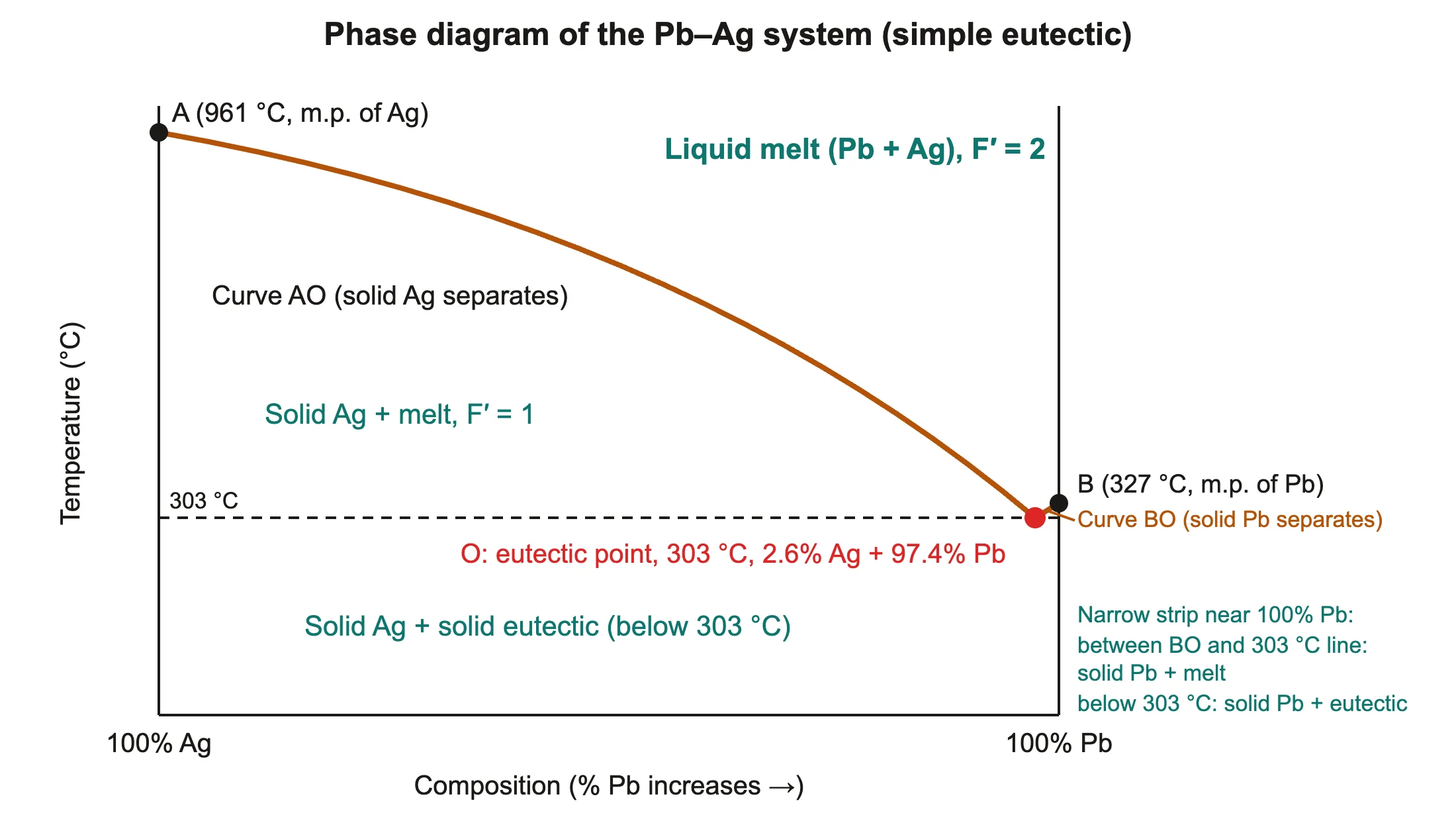
The Pb–Ag system is a two-component, simple eutectic system. It is a condensed system (solid and liquid only; the vapour phase is negligible), so pressure is taken as constant and the reduced phase rule is used: F′ = C − P + 1.
Explanation:
- Point A (961 °C): melting point of pure silver. Point B (327 °C): melting point of pure lead.
- Curve AO (freezing point curve of Ag): adding Pb to Ag lowers the melting point of Ag along AO. Along this curve, solid Ag is in equilibrium with the melt. P = 2, so F′ = 2 − 2 + 1 = 1 (univariant).
- Curve BO (freezing point curve of Pb): adding Ag to Pb lowers the melting point of Pb along BO. Along this curve, solid Pb is in equilibrium with the melt. F′ = 1.
- Eutectic point O (303 °C, 2.6% Ag + 97.4% Pb): the two curves meet here. Three phases are in equilibrium: solid Ag, solid Pb and the melt. F′ = 2 − 3 + 1 = 0 (invariant). This is the lowest temperature at which a liquid can exist in this system.
- Area above AOB: only the liquid melt. P = 1, so F′ = 2 − 1 + 1 = 2: both temperature and composition must be fixed.
- Area below AO (above 303 °C): solid Ag + melt. Area below BO: solid Pb + melt. In both, F′ = 1.
- Below the eutectic line (303 °C): only solids: solid Ag + eutectic, or solid Pb + eutectic.
Application: Pattinson's process (desilverisation of lead). Argentiferous lead contains only about 0.1% Ag. When this melt is cooled, pure lead separates along curve BO and is removed. The remaining melt becomes richer in silver, up to 2.6% at the eutectic point. Silver is then recovered from this enriched alloy.
Q5. Explain the synthesis of adipic acid by the traditional and green pathways. Also write the green chemistry principles involved
Traditional route (from benzene)
- Benzene + 3H2 → (Ni catalyst, high T and P) → cyclohexane
- Cyclohexane + O2 (air) → (Co catalyst) → cyclohexanol + cyclohexanone (called "KA oil")
- KA oil + HNO3 (oxidation) → adipic acid HOOC–(CH2)4–COOH + N2O
Drawbacks: benzene is a carcinogen and comes from petroleum (non-renewable). Nitric acid is corrosive. The by-product N2O is a greenhouse gas that also damages the ozone layer. High temperature and pressure use a lot of energy.
Green route (from glucose)
- D-glucose → (genetically modified E. coli bacteria, in water) → cis,cis-muconic acid
- cis,cis-Muconic acid + 2H2 → (Pt catalyst, mild pressure) → adipic acid
(Another green route: cyclohexene + 30% H2O2 with a sodium tungstate catalyst gives adipic acid and water only, with no organic solvent.)
Green chemistry principles involved
- Use of renewable feedstock: glucose (from starch or sugar) replaces benzene from petroleum.
- Less hazardous chemical synthesis: no carcinogenic benzene and no nitric acid.
- Prevention of waste / pollution: no N2O greenhouse gas is formed.
- Catalysis: enzymes (biocatalysts) and a metal catalyst are used.
- Safer solvent and energy efficiency: the reaction runs in water at mild conditions.
Q6. Explain the synthesis of indigo dye by the conventional and green routes. Also write the green chemistry principles involved
Conventional route (Heumann–Pfleger process, from aniline)
- Aniline + formaldehyde + hydrogen cyanide (HCN) → N-phenylglycinonitrile
- Hydrolysis → N-phenylglycine
- N-phenylglycine fused with NaNH2 + NaOH/KOH at high temperature → indoxyl
- Indoxyl + O2 (air oxidation) → indigo
Drawbacks: uses highly toxic HCN and toxic aniline (both from petroleum), strong corrosive bases, and high temperature. It produces a lot of toxic waste.
Green route (biocatalytic, using bacteria)
- Glucose → (genetically engineered E. coli) → tryptophan
- Tryptophan → (enzyme tryptophanase) → indole
- Indole → (enzyme naphthalene dioxygenase) → indoxyl
- Indoxyl + O2 (air) → indigo
Green chemistry principles involved
- Renewable feedstock: glucose instead of aniline from petroleum.
- Less hazardous synthesis: no HCN and no strong bases.
- Catalysis: enzymes are used as catalysts.
- Safer solvents: water is the medium.
- Design for energy efficiency: runs at room temperature and pressure.
- Prevention of waste: much less toxic waste.
Q7. What is biodiesel? Explain the transesterification method for its synthesis. Mention the advantages of biodiesel as a fuel
Biodiesel: Biodiesel is a mixture of mono-alkyl (mostly methyl) esters of long-chain fatty acids, obtained from vegetable oils (jatropha, karanja, soybean, palm) or animal fats. It can be used in diesel engines alone or blended with diesel (for example, B20 = 20% biodiesel + 80% diesel).
Transesterification method
Vegetable oil (a triglyceride) reacts with methanol in the presence of a base catalyst (NaOH or KOH) to give methyl esters (biodiesel) and glycerol.
Triglyceride + 3 CH3OH → (NaOH/KOH, about 60–65 °C) → 3 RCOOCH3 (biodiesel) + glycerol
Steps:
- The oil is filtered and heated to remove water.
- NaOH or KOH is dissolved in methanol to form sodium/potassium methoxide.
- The methoxide is mixed with the oil and stirred at about 60–65 °C for 1–2 hours.
- The mixture is allowed to settle. Glycerol (denser) forms the lower layer and is removed.
- The upper layer (methyl esters) is washed with water to remove the catalyst, soap and excess methanol, then dried. This is biodiesel.
Advantages of biodiesel
- Renewable: made from plant oils.
- Biodegradable and non-toxic.
- Contains almost no sulphur, so no SO2 is formed.
- Less CO, unburnt hydrocarbons and smoke (particulates) because it contains oxygen and burns more completely.
- Higher flash point, so it is safer to store and transport.
- Higher cetane number and good lubricity, which reduces engine wear.
- Can be used in existing diesel engines with little or no change.
- Reduces dependence on imported petroleum.
Q8. Explain the manufacture of power alcohol from molasses with reactions, and write its advantages
Power alcohol: Ethyl alcohol (ethanol) mixed with petrol (usually 5–25%) and used as fuel in internal combustion engines is called power alcohol.
Manufacture from molasses
Molasses is the dark, thick liquid left after sugar crystallises in the sugar industry. It still contains about 50–60% sugar (mainly sucrose).
- Dilution: molasses is diluted with water to about 10–15% sugar.
- Acidification: a little H2SO4 is added to bring the pH to about 4–5. This helps yeast and stops harmful bacteria.
- Nutrients: ammonium sulphate or ammonium phosphate is added as food for the yeast.
- Fermentation: yeast is added and the mixture is kept at about 30 °C for 2–3 days. The enzymes in yeast do the reactions:
- C12H22O11 (sucrose) + H2O → (invertase) → C6H12O6 (glucose) + C6H12O6 (fructose)
- C6H12O6 → (zymase) → 2 C2H5OH + 2 CO2↑
- Distillation: the fermented liquid ("wash") contains about 15–18% alcohol. Fractional distillation gives rectified spirit (95.6% ethanol).
- Absolute alcohol: the last 4.4% water cannot be removed by simple distillation (azeotrope). It is removed by azeotropic distillation with benzene, or by dehydrating agents/molecular sieves, to get 100% (absolute) alcohol.
- Blending: absolute alcohol is mixed with petrol. It must be water-free, because water makes alcohol and petrol separate into two layers.
Advantages of power alcohol
- Renewable: made from sugarcane by-products.
- High octane number, so it has good anti-knock properties.
- Burns more completely, giving less CO and fewer hydrocarbons, so less pollution.
- Uses molasses, a waste product of the sugar industry.
- Reduces petrol consumption and import costs.
- Can be used in ordinary petrol engines when blended in small amounts.
Disadvantage (if asked): its calorific value is lower than petrol (about 7000 kcal/kg against about 11,000 kcal/kg), so mileage is slightly lower.
Q9. Define matrix phase and dispersed phase. Give the functions of the matrix phase
Matrix phase: the continuous phase of a composite that surrounds and holds the dispersed phase and gives the composite its bulk shape. It can be a polymer, a metal or a ceramic.
Dispersed phase (reinforcement): the discontinuous phase embedded in the matrix, in the form of fibres, particles or flakes. It gives the composite its strength and stiffness. Example: glass fibres in an epoxy matrix.
Functions of the matrix phase
- Binds the dispersed phase (fibres or particles) together.
- Transfers and distributes the applied load to the reinforcement.
- Protects the reinforcement from chemical attack, moisture and surface damage (abrasion).
- Keeps the fibres separated, so a crack in one fibre does not spread to others (it stops crack propagation).
- Holds the fibres in the correct position and direction.
- Gives the composite its shape, surface finish, ductility and toughness.
- Decides the maximum working temperature of the composite.
Q10. Write the applications of composite materials
- Aerospace: aircraft wings, fuselage parts, tail and helicopter rotor blades (carbon fibre and glass fibre composites are light and strong).
- Automobiles: body panels, bumpers, drive shafts, brake pads and leaf springs.
- Marine: boat hulls, decks and ship parts (they do not corrode in sea water).
- Sports goods: tennis and badminton rackets, golf club shafts, bicycle frames, fishing rods, helmets.
- Construction: reinforced cement concrete (RCC), FRP doors, panels, bridges and pipes.
- Electrical and electronics: printed circuit boards, insulators, switchgear parts.
- Chemical industry: storage tanks, pipes and ducts that resist corrosion.
- Medical: artificial limbs, dental fillings, bone implants.
- Energy: wind turbine blades.
Q11. Explain laminar and sandwich panels of structural composites
Structural composites are made from layers or panels. Their properties depend on the materials and on how the layers are arranged (geometric design). They are of two types:
(a) Laminar composites
- Made of two-dimensional sheets or panels (called layers or plies) stacked and bonded together.
- Each layer has a preferred direction of high strength (for example, fibres aligned in one direction).
- The direction changes from layer to layer (for example, 0° and 90°), so the final sheet is strong in many directions in its plane.
- Examples: plywood (wood layers with grain at right angles), laminated safety glass (car windscreens), Formica sheets, carbon fibre laminates in aircraft.
(b) Sandwich panels
- Made of two thin, strong and stiff outer sheets (faces) bonded to a thick, light core in between.
- Face materials: aluminium alloys, fibre-reinforced plastics, titanium, steel or plywood.
- Core materials: honeycomb structure (aluminium or paper), polymer foams (polyurethane), balsa wood, synthetic rubber.
- Working: the faces carry the bending loads (tension on one face, compression on the other). The core keeps the faces apart and carries shear stress. This gives high stiffness and strength at low weight.
- Applications: aircraft floors, walls and wings; roofs, floors and walls of buildings; refrigerator and cold-storage panels; boat hulls; helicopter rotor blades.
Q12. Define composites and write the characteristics of composite materials
Composite: a composite material is made by combining two or more different materials (with different physical and chemical properties) on a macroscopic scale. The constituents stay separate and distinct in the final material, and together they give properties better than either constituent alone. A composite has a matrix phase and a dispersed phase. Examples: fibre-reinforced plastic (FRP), RCC, plywood.
Characteristics of composite materials
- High strength-to-weight and stiffness-to-weight ratio (strong but light).
- Low density.
- Good resistance to corrosion and chemicals.
- High fatigue strength and impact resistance (toughness).
- Low thermal expansion, so good dimensional stability.
- Good thermal and electrical insulation (polymer composites).
- Good creep resistance and can work at high temperature (ceramic and metal matrix composites).
- Properties can be designed for the job (tailor-made) by choosing the matrix, the reinforcement and the fibre direction.
- Can be moulded into complex shapes.
More solved questions for these chapters: Alloys · Composites · Green chemistry · Fuels. Previous papers: MU FE Sem 1 Applied Chemistry, December 2025.