
I want to make short notes of phenol chemical reaction and preparation Like
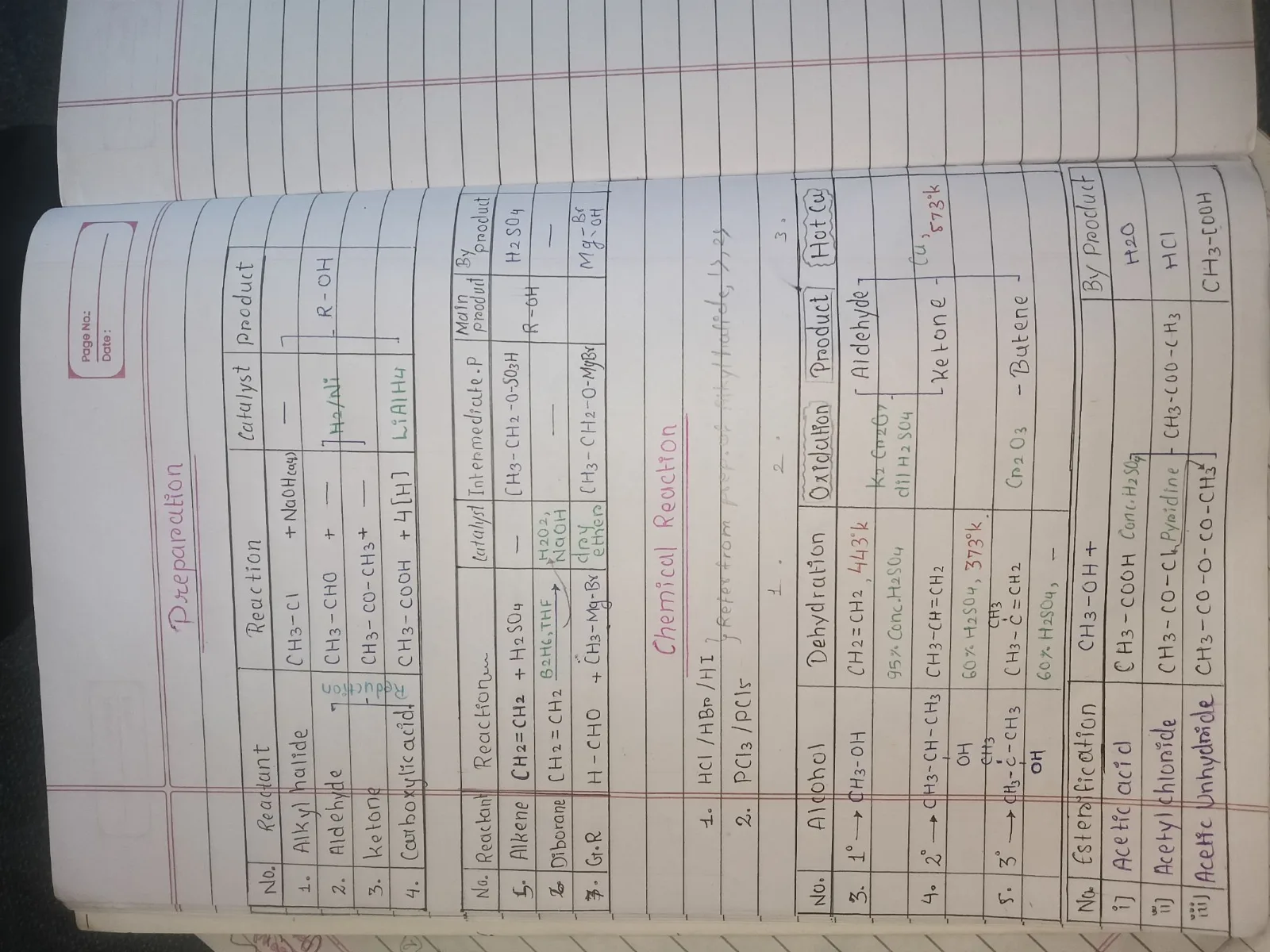
Here are short notes on phenol in the same table style as your alcohol notes (HSC Chemistry, chapter: Alcohols, Phenols and Ethers).
| No. | Starting compound | Reagent / conditions | Intermediate | Product |
|---|---|---|---|---|
| 1 | Chlorobenzene (C6H5Cl) (Dow process) | NaOH, 623 K, 300 atm; then dil. HCl | Sodium phenoxide (C6H5ONa) | Phenol |
| 2 | Benzene sulphonic acid (C6H5SO3H) (from benzene + oleum) | Fuse with molten NaOH; then dil. HCl | Sodium phenoxide | Phenol |
| 3 | Aniline (C6H5NH2) | NaNO2 + HCl at 273–278 K; then warm with water | Benzene diazonium chloride (C6H5N2Cl) | Phenol + N2↑ + HCl |
| 4 | Cumene (isopropyl benzene) | O2 (air); then dil. H2SO4 | Cumene hydroperoxide | Phenol + acetone (by-product) |
Remember: the cumene method is the main industrial method, and acetone is the by-product.
| No. | Reaction | Reagent | Product | Note |
|---|---|---|---|---|
| 1 | With sodium | Na | Sodium phenoxide + H2↑ | Phenol is acidic |
| 2 | With NaOH | aq. NaOH | Sodium phenoxide + H2O | Alcohols do not react with NaOH |
| 3 | With NaHCO3 | NaHCO3 | No reaction | Phenol is weaker than carbonic acid (no CO2 gas) |
| 4 | Esterification (acetylation) | Acetic anhydride or acetyl chloride, pyridine | Phenyl acetate | — |
| 5 | Benzoylation (Schotten–Baumann) | Benzoyl chloride + aq. NaOH | Phenyl benzoate | — |
| 6 | With zinc dust | Zn dust, heat | Benzene + ZnO | –OH removed |
The –OH group activates the ring and directs to ortho and para positions.
| No. | Reaction | Reagent / conditions | Product |
|---|---|---|---|
| 7 | Bromination (mild) | Br2 in CS2 or CHCl3, 273 K | o-Bromophenol + p-bromophenol (para major) |
| 8 | Bromination (bromine water) | Br2 water | 2,4,6-Tribromophenol (white ppt.) |
| 9 | Nitration (dilute) | dil. HNO3, 298 K | o-Nitrophenol + p-nitrophenol (separated by steam distillation; ortho is steam volatile) |
| 10 | Nitration (concentrated) | conc. HNO3 + conc. H2SO4 | 2,4,6-Trinitrophenol (picric acid) |
| 11 | Kolbe's reaction | Sodium phenoxide + CO2, 400 K, 4–7 atm; then H+ | Salicylic acid (o-hydroxybenzoic acid) |
| 12 | Reimer–Tiemann reaction | CHCl3 + aq. NaOH, 340 K; then H+ | Salicylaldehyde (o-hydroxybenzaldehyde) |
| No. | Reaction | Reagent | Product / observation |
|---|---|---|---|
| 13 | Oxidation | Na2Cr2O7 + H2SO4 | p-Benzoquinone |
| 14 | Ferric chloride test | neutral FeCl3 | Violet colour (test for phenol) |
Practise this chapter: Alcohols, Phenols and Ethers: chapter test and solved questions.
Log in or create a free account to answer this question.