Chapter: Elements of Group 1 and 2· Chemistry
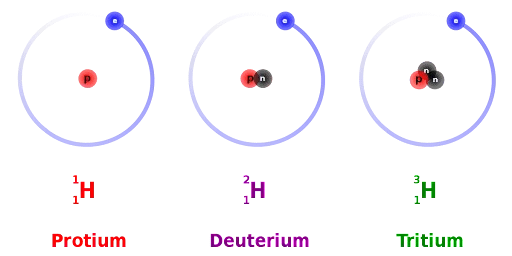
- Hydrogen has three isotopes i.e., hydrogen \(\left({ }_{1}^{1} \mathrm{H}\right)\), deuterium \(\left({ }_{1}^{2} \mathrm{H}\right)\) and tritium \(\left({ }_{1}^{3} \mathrm{H}\right)\) with mass numbers 1, 2 and 3 respectively.
- They all contain one proton and one electron but different number of neutrons in the nucleus.
- Atomic composition of isotopes of hydrogen:
Name of the isotope Symbol Atomic number Z Atomic mass number A Neutron number N Abundance Stability Hydrogen \[\ce{H or _1^1H or H-1}\] 1 1 0 99.98% Stable Deuterium \[\ce{D or _1^2H or H-2}\] 1 2 1 0.015% Stable Tritium \[\ce{T or _1^3H or H-3}\] 1 3 2 Trace Radioactive - Tritium is a radioactive nuclide with a half-life period of 12.4 years and emits low energy β particles.
- Schematic representation of isotopes of hydrogen is as follows: