2 answers
Best answer
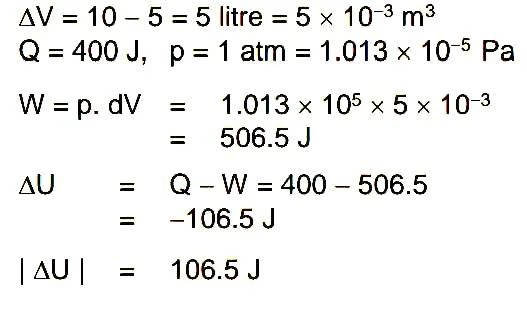
Answer: \(\Delta U = -106.5\ \text{J}\) (internal energy decreases by 106.5 J)
Given: \(P = 1\ \text{atm} = 1.013\times10^{5}\ \text{Pa}\), \(V_1 = 5\ \text{L}\), \(V_2 = 10\ \text{L}\), heat absorbed \(Q = +400\ \text{J}\)
\(\Delta V = 10 - 5 = 5\ \text{L} = 5\times10^{-3}\ \text{m}^3\)
Work done by the gas against the constant external pressure:
\(W = P\Delta V = 1.013\times10^{5}\times5\times10^{-3} = 506.5\ \text{J}\)
First law of thermodynamics: \(Q = \Delta U + W\)
\(\Delta U = Q - W = 400 - 506.5 = -106.5\ \text{J}\)
The gas does 506.5 J of work but receives only 400 J of heat, so the remaining 106.5 J comes from its internal energy. Hence internal energy decreases by 106.5 J.

Answer: \(\Delta U = -106.5\) J (the internal energy decreases by 106.5 J)
Work done by the gas against constant external pressure:
\(P = 1\ \text{atm} = 1.013\times10^{5}\) Pa
\(\Delta V = 10 - 5 = 5\ \text{L} = 5\times10^{-3}\ \text{m}^3\)
\[W = P\Delta V = 1.013\times10^{5}\times5\times10^{-3} = 506.5\ \text{J}\]
\(W\) is positive because the gas expands (work done by the system).
First law of thermodynamics: \(Q = \Delta U + W\), with \(Q = +400\) J (heat absorbed).
\[\Delta U = Q - W = 400 - 506.5 = -106.5\ \text{J}\]
The gas does more work than the heat it absorbs, so it uses some of its own internal energy: its internal energy falls by 106.5 J.
Your answer
Log in or create a free account to answer this question.