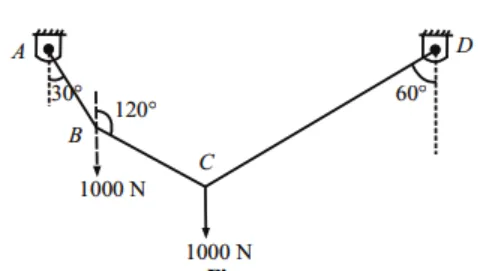
Answer: \(T_{AB} \approx 1732\) N, \(T_{BC} = 1000\) N, \(T_{CD} = 1000\) N (BC makes 60° with the vertical)
Take A on the left and D on the right, with AB at 30° and CD at 60° to the vertical.
Whole string B–C as one body (BC is internal). Horizontal balance:
\[T_{AB}\sin30^\circ = T_{CD}\sin60^\circ\]
\[T_{AB} = \sqrt3\,T_{CD}\]
Vertical balance:
\[T_{AB}\cos30^\circ + T_{CD}\cos60^\circ = 2000\]
Substituting: \(\tfrac32 T_{CD} + \tfrac12 T_{CD} = 2000\), so
\[T_{CD} = 1000\ \text{N},\quad T_{AB} = 1732\ \text{N}\]
Joint B. BC must balance the rest of the forces at B:
Horizontal: \(T_{BC}\sin\theta = 1732\sin30^\circ = 866\) N
Vertical: \(T_{BC}\cos\theta = 1732\cos30^\circ - 1000 = 500\) N
\[T_{BC} = \sqrt{866^2 + 500^2} = 1000\ \text{N}\]
\(\tan\theta = 866/500 = \sqrt3\), so BC is inclined at 60° to the vertical (30° to the horizontal).
Check at C: horizontal \(1000\sin60^\circ = 866\) and vertical \(1000\cos60^\circ + 500 = 1000\) N, matching the load. Correct.