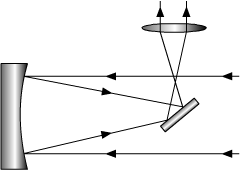
Answer: (a) Newtonian telescope; (c) it uses a concave mirror and a plane mirror; (d) Cassegrain telescope.
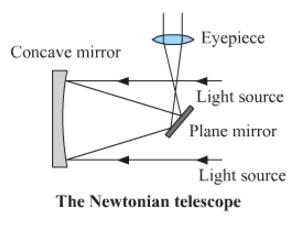
a. The figure shows a Newtonian (reflecting) telescope.
b. Main parts of the telescope:
- Tube – open at one end, through which light from the heavenly body enters.
- Concave mirror (primary mirror) – at the bottom (closed end) of the tube; it reflects and converges the light.
- Plane mirror (secondary mirror) – placed at 45° near the open end, before the focus of the concave mirror; it turns the converging rays sideways.
- Eyepiece (lens) – fixed on the side of the tube; it forms a magnified image seen by the eye.
c. It uses a concave mirror (a curved, spherical mirror) as the main mirror and a plane mirror as the secondary mirror.
d. The Cassegrain telescope also uses a curved mirror (a concave primary mirror and a small convex secondary mirror).
e. Working: Light rays from a distant heavenly body enter the tube and fall on the concave mirror. The concave mirror reflects them so that they converge. Before they meet at its focus, the plane mirror reflects them sideways towards the eyepiece. The rays meet near the eyepiece, which forms a magnified image of the body.