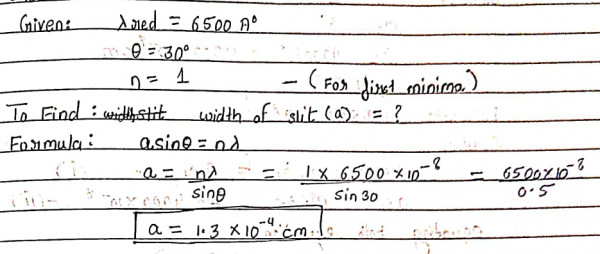
Answer: \(a = 1.3 \times 10^{-6}\ \text{m} = 1.3\ \mu\text{m}\) (13000 Å)
For single-slit (Fraunhofer) diffraction, the minima occur where
\[ a\sin\theta = n\lambda \]
For the first minimum, \(n = 1\). Given \(\theta = 30^\circ\) (the "300" in the question is \(30^\circ\)) and \(\lambda = 6500\ \text{Å} = 6.5 \times 10^{-7}\ \text{m}\):
\[ a = \frac{\lambda}{\sin 30^\circ} = \frac{6.5 \times 10^{-7}}{0.5} \]
\[ a = 1.3 \times 10^{-6}\ \text{m} \]
So the slit must be 1.3 μm wide, which is just twice the wavelength of red light. Such a narrow slit spreads the light out widely, which is why the first minimum is at an angle as large as 30°.