
Calculate the angular separation between the first order minima on either side of central maxima when slit is6
Calculate the angular separation between the first order minima on either side of central maxima when slit is6 X 10-4 cm wide & λ=6000A0.
Calculate the angular separation between the first order minima on either side of central maxima when slit is6 X 10-4 cm wide & λ=6000A0.
Best answer
Answer: Angular separation \(2\theta = 11.48^\circ\) (each first minimum at \(\theta = 5.74^\circ\))
Given: \(a = 6 \times 10^{-4}\) cm \(= 6 \times 10^{-6}\) m, \(\lambda = 6000\ \text{Å} = 6 \times 10^{-7}\) m.
First minimum: \(a\sin\theta = \lambda\)
\(\sin\theta = \dfrac{6 \times 10^{-7}}{6 \times 10^{-6}} = 0.1 \Rightarrow \theta = 5.74^\circ\)
The first minima lie at \(\pm\theta\) on either side of the central maximum, so the angular separation is
\(2\theta = 2 \times 5.74^\circ = 11.48^\circ\ (\approx 0.2\ \text{rad})\)
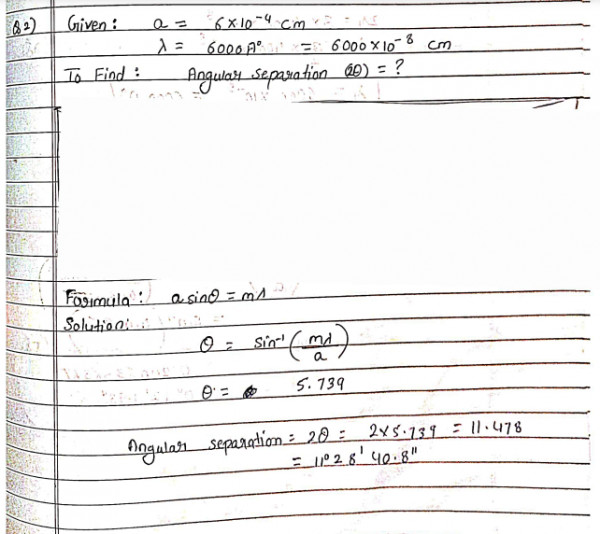
Answer: Angular separation \(= 2\theta \approx 11.48^\circ\) (about 0.20 rad)
For single-slit diffraction, the first minimum on each side of the central maximum is at
\[a\sin\theta = \lambda\]
Given: \(a = 6\times10^{-4}\ \mathrm{cm} = 6\times10^{-6}\ \mathrm{m}\), \(\lambda = 6000\ \text{Å} = 6\times10^{-7}\ \mathrm{m}\).
\[\sin\theta = \frac{6\times10^{-7}}{6\times10^{-6}} = 0.1\]
\[\theta = \sin^{-1}(0.1) \approx 5.74^\circ\]
The two first-order minima lie at \(+\theta\) and \(-\theta\), so the angular separation between them is
\[2\theta \approx 11.48^\circ \approx 0.20\ \mathrm{rad}\]
Log in or create a free account to answer this question.