
A slit of width 0.16 mm is illuminated by a monochromatic light of wavelength 5600A0
A slit of width 0.16 mm is illuminated by a monochromatic light of wavelength 5600A0.Find half angular width of a principal maxima
A slit of width 0.16 mm is illuminated by a monochromatic light of wavelength 5600A0.Find half angular width of a principal maxima
Best answer
Answer: Half angular width \(\theta = 3.5 \times 10^{-3}\ \text{rad} \approx 0.20^\circ\)
Given: \(a = 0.16\) mm \(= 1.6 \times 10^{-4}\) m, \(\lambda = 5600\ \text{Å} = 5.6 \times 10^{-7}\) m.
The half angular width of the central (principal) maximum is the angle of the first minimum: \(a\sin\theta = \lambda\).
\(\sin\theta = \dfrac{5.6 \times 10^{-7}}{1.6 \times 10^{-4}} = 3.5 \times 10^{-3}\)
Since the angle is small, \(\theta \approx \sin\theta = 3.5 \times 10^{-3}\) rad \(= 0.20^\circ\).
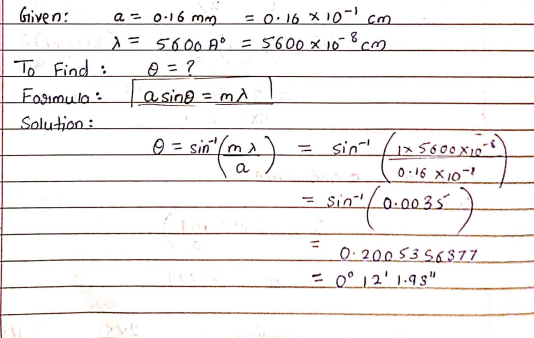
Answer: Half angular width \(\theta \approx 3.5\times10^{-3}\) rad \(\approx 0.20^\circ\)
The half angular width of the central (principal) maximum is the angle of the first minimum:
\[a\sin\theta = \lambda\]
Given: \(a = 0.16\ \mathrm{mm} = 1.6\times10^{-4}\ \mathrm{m}\), \(\lambda = 5600\ \text{Å} = 5.6\times10^{-7}\ \mathrm{m}\).
\[\sin\theta = \frac{5.6\times10^{-7}}{1.6\times10^{-4}} = 3.5\times10^{-3}\]
Since the angle is small, \(\theta \approx 3.5\times10^{-3}\) rad, which is about \(0.20^\circ\).
Log in or create a free account to answer this question.