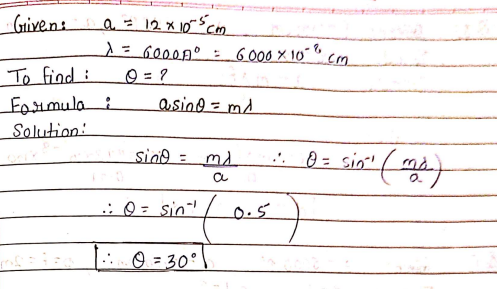
Answer: The half angular width of the central maximum is 30°.
For Fraunhofer diffraction at a single slit of width \(a\), the first minimum on either side of the central maximum is at
\[a\sin\theta = \lambda\]
The angle \(\theta\) of this first minimum is the half angular width of the central maximum.
Given: \(a = 12\times10^{-5}\ \text{cm}\), \(\lambda = 6000\ \text{Å} = 6000\times10^{-8}\ \text{cm} = 6\times10^{-5}\ \text{cm}\).
\[\sin\theta = \frac{\lambda}{a} = \frac{6\times10^{-5}}{12\times10^{-5}} = 0.5\]
\[\theta = 30^\circ\]
So the central maximum spreads 30° on each side of the centre, a total angular width of 60°.