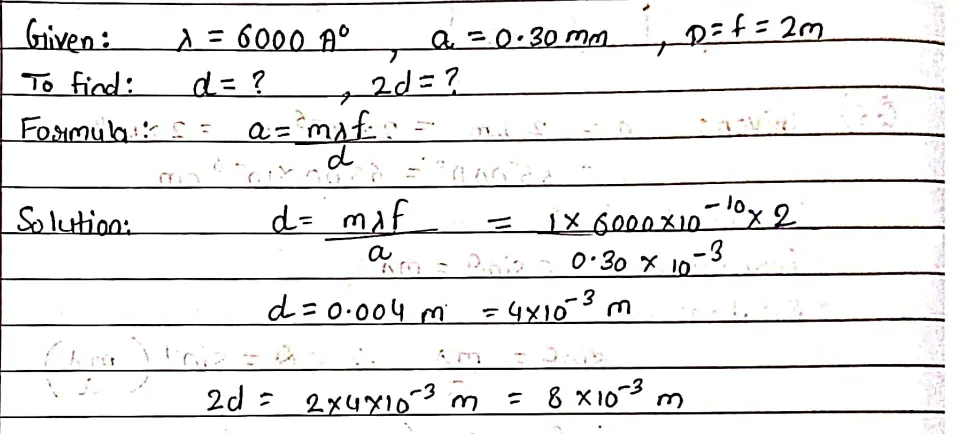
Answer: (a) First dark fringe at \(4 \times 10^{-3}\ \text{m} = 4\ \text{mm}\) from the centre; (b) width of central maximum \(= 8 \times 10^{-3}\ \text{m} = 8\ \text{mm}\)
Given: \(\lambda = 6000\ \text{Å} = 6 \times 10^{-7}\) m, \(a = 0.30\) mm \(= 3 \times 10^{-4}\) m, \(D = 2\) m.
(a) First dark fringe: \(a\sin\theta = \lambda\), and for small \(\theta\), \(y_1 = \dfrac{\lambda D}{a}\)
\(y_1 = \dfrac{6 \times 10^{-7} \times 2}{3 \times 10^{-4}} = 4 \times 10^{-3}\ \text{m}\)
(b) The central maximum extends from the first minimum on one side to the first minimum on the other side:
Width \(= 2y_1 = 2 \times 4 \times 10^{-3} = 8 \times 10^{-3}\ \text{m}\)