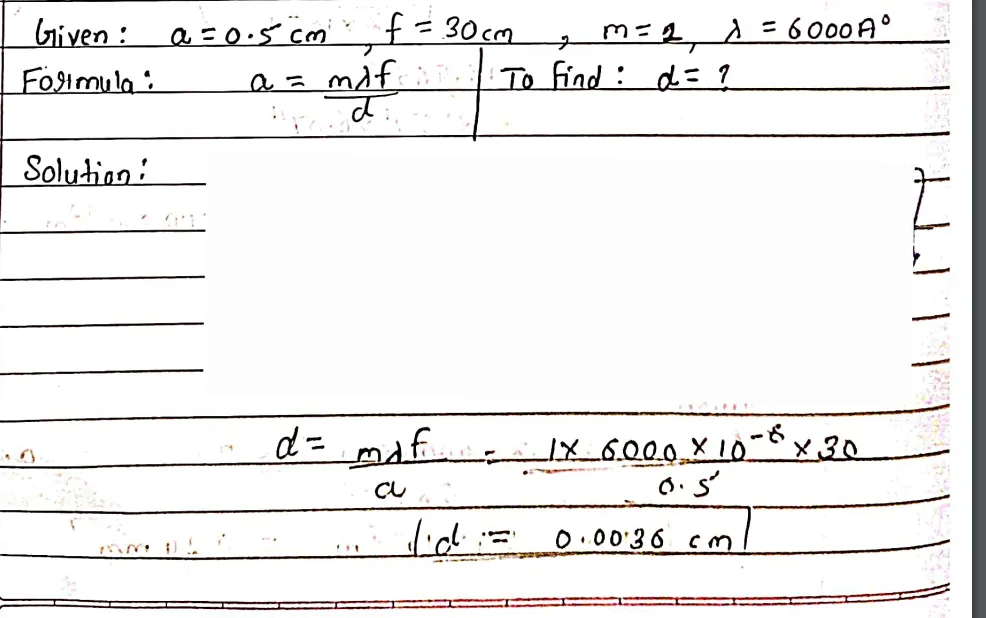
Answer: First dark fringe at 0.0036 cm, next bright fringe at 0.0054 cm; distance between them = 0.0018 cm
Given: \(a = 0.5\ \mathrm{cm}\), \(f = 30\ \mathrm{cm}\), \(\lambda = 6000\ \text{Å} = 6\times10^{-5}\ \mathrm{cm}\).
For small angles, the distance from the axis on the screen (in the focal plane) is \(y = f\theta\).
First dark fringe: \(a\sin\theta = \lambda\)
\[y_1 = \frac{f\lambda}{a} = \frac{30\times6\times10^{-5}}{0.5}\]
\[y_1 = 3.6\times10^{-3}\ \mathrm{cm}\]
Next (first secondary) bright fringe: \(a\sin\theta \approx \dfrac{3\lambda}{2}\)
\[y_2 = \frac{3f\lambda}{2a} = 5.4\times10^{-3}\ \mathrm{cm}\]
Distance between the first dark and the next bright fringe:
\[y_2 - y_1 = 1.8\times10^{-3}\ \mathrm{cm}\]