Skip to content
doubtly

2 answers

Best answer

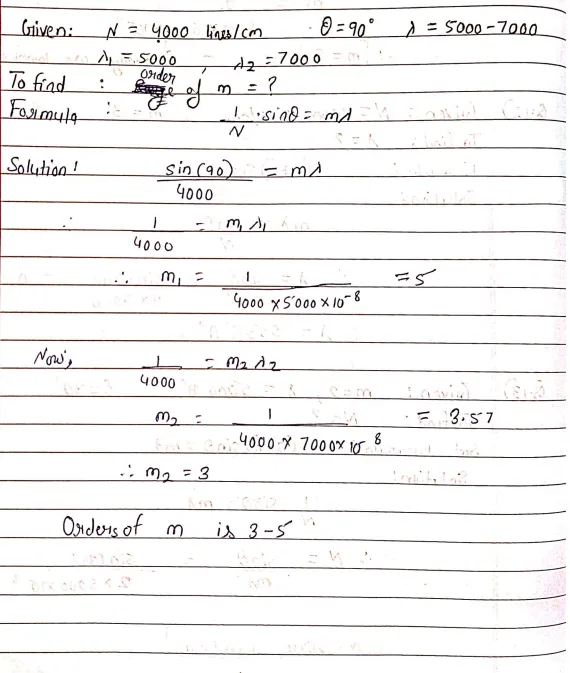
Answer: The complete spectrum (5000 Å to 7000 Å) is seen in orders 1, 2 and 3, i.e. 3 complete orders; the shorter wavelengths also appear in the 4th order.

Grating equation: \((a+b)\sin\theta = n\lambda\), so \(n_{max} = \dfrac{a+b}{\lambda}\) (taking \(\sin\theta = 1\)).

\((a+b) = \dfrac{1}{4000}\ \text{cm} = 2.5 \times 10^{-4}\) cm.

For \(\lambda = 5000\ \text{Å} = 5 \times 10^{-5}\) cm: \(n_{max} = \dfrac{2.5 \times 10^{-4}}{5 \times 10^{-5}} = 5\). The 5th order would be exactly at \(90^\circ\) (grazing), so it is not actually observed; 5000 Å is seen up to the 4th order.

For \(\lambda = 7000\ \text{Å} = 7 \times 10^{-5}\) cm: \(n_{max} = \dfrac{2.5 \times 10^{-4}}{7 \times 10^{-5}} = 3.57\), so only up to the 3rd order.

Hence all wavelengths of the range appear only up to the 3rd order: 3 complete orders. In the 4th order only wavelengths with \(4\lambda < 2.5 \times 10^{-4}\) cm, i.e. \(\lambda < 6250\ \text{Å}\), are seen (a partial spectrum).
image

Doubtly · 10 Apr 2022 Report
Was this answer helpful?

Answer: Complete spectra are seen up to the 3rd order (the 4th order is seen only partly)

Grating element:

\[d = \frac{1}{4000}\ \mathrm{cm} = 2.5\times10^{-4}\ \mathrm{cm}\]

Grating equation: \(d\sin\theta = n\lambda\). The largest possible order needs \(\sin\theta \le 1\), so \(n_{\max} = d/\lambda\).

  • For \(\lambda = 7000\ \text{Å} = 7\times10^{-5}\) cm: \(n_{\max} = \dfrac{2.5\times10^{-4}}{7\times10^{-5}} = 3.57\), so up to order 3.
  • For \(\lambda = 5000\ \text{Å} = 5\times10^{-5}\) cm: \(n_{\max} = 5\), but order 5 would be at \(\theta = 90^\circ\), which cannot be observed, so up to order 4.

So the whole range 5000–7000 Å appears in the 1st, 2nd and 3rd orders. In the 4th order only wavelengths up to \(d/4 = 6250\ \text{Å}\) appear, so that spectrum is incomplete.

Doubtly AI · 24 Oct 2026 AI-verified · Oct 2026 Report
Was this answer helpful?

Your answer

Log in or create a free account to answer this question.