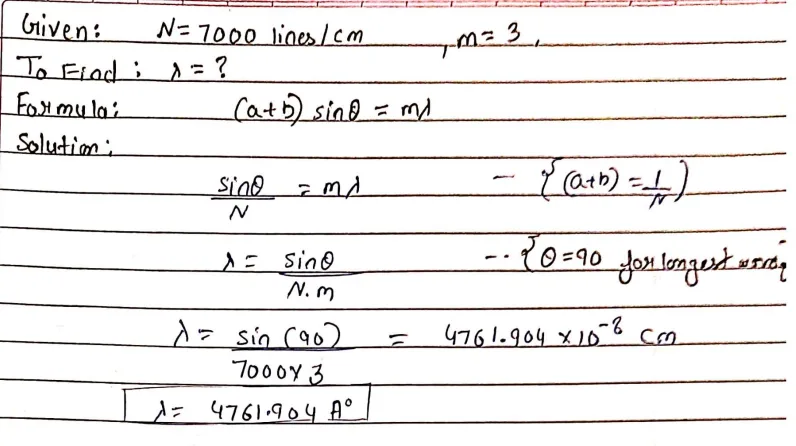
Answer: \(\lambda_{max} = 4.762 \times 10^{-5}\ \text{cm} \approx 4762\ \text{Å}\)
Grating equation: \((a+b)\sin\theta = n\lambda\). The longest wavelength in a given order corresponds to the largest angle, \(\sin\theta = 1\).
\((a+b) = \dfrac{1}{7000}\ \text{cm} = 1.429 \times 10^{-4}\) cm, \(n = 3\).
\(\lambda_{max} = \dfrac{a+b}{3} = \dfrac{1.429 \times 10^{-4}}{3} = 4.762 \times 10^{-5}\ \text{cm} = 4762\ \text{Å}\)
(Strictly, this wavelength would appear at \(90^\circ\), so wavelengths just shorter than 4762 Å are actually observed in the 3rd order.)