
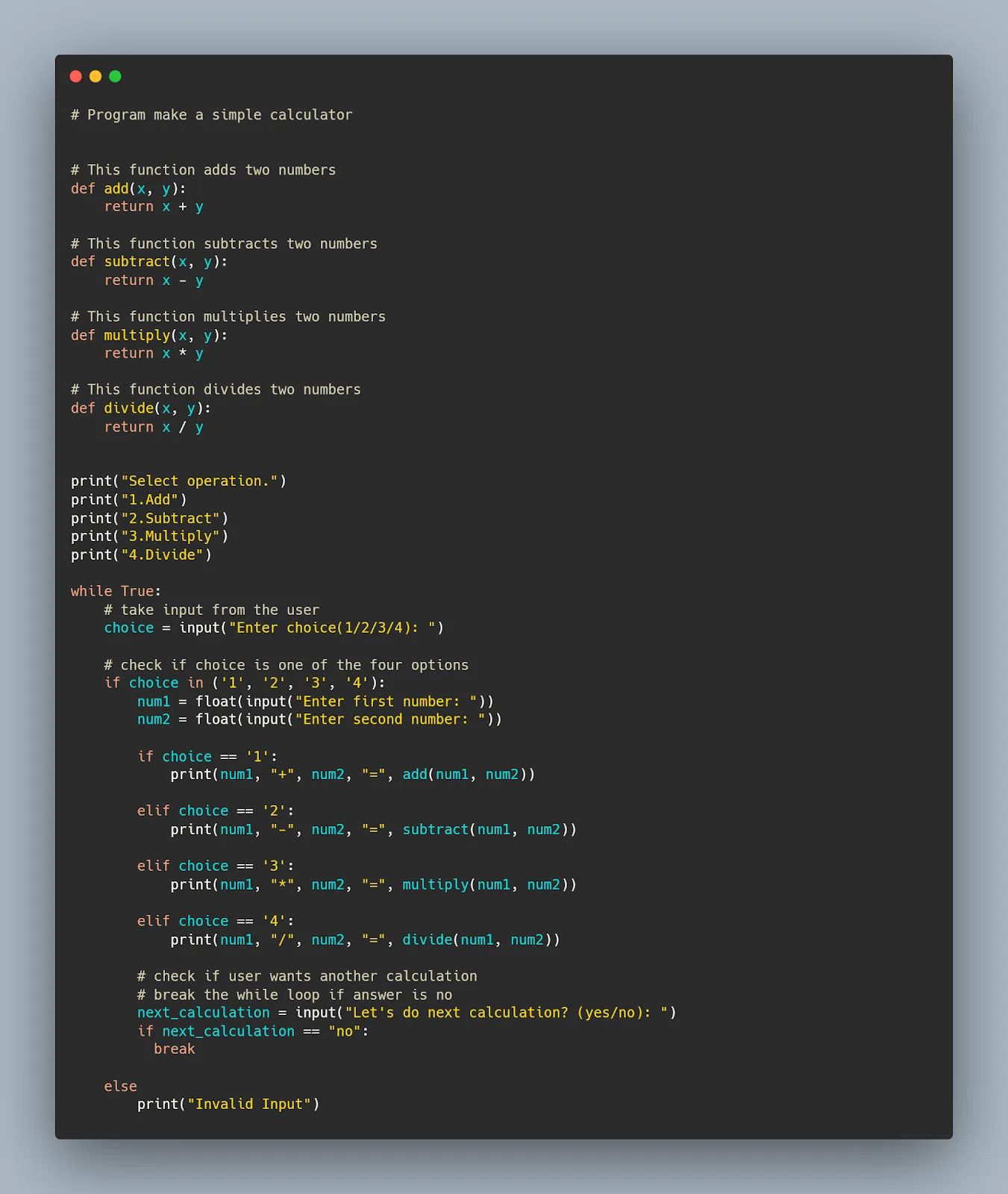
Code for simple calculator in python , you can try below code by opening in new window if any doubt ask related question or comment feel free to message me here !
Best answer
Code for simple calculator in python , you can try below code by opening in new window if any doubt ask related question or comment feel free to message me here !
A simple calculator in Python reads two numbers and an operator, then uses if-elif-else to perform the chosen operation.
# Simple Calculator
def calculate(a, op, b):
    if op == '+':
        return a + b
    elif op == '-':
        return a - b
    elif op == '*':
        return a * b
    elif op == '/':
        if b == 0:
            return "Error: division by zero"
        return a / b
    else:
        return "Invalid operator"

while True:
    a = float(input("Enter first number: "))
    op = input("Enter operator (+, -, *, /): ")
    b = float(input("Enter second number: "))
    print("Result:", calculate(a, op, b))
    again = input("Calculate again? (y/n): ")
    if again.lower() != 'y':
        break
print("Thank you!")
How it works:
float(input(...)) converts the typed text into a number.calculate() checks the operator with if-elif and returns the result; it also avoids division by zero.while True loop lets the user do several calculations; break ends it when the user types anything other than y.Sample run: entering 12, *, 3 prints Result: 36.0.
Log in or create a free account to answer this question.