
Statement- “the sum of squares of any of the two sides of a triangle
equals to twice its square on half of the third side,
along with the twice of its square on the median
bisecting the third side”
https://youtu.be/y1IK1RCbPm8
Best answer
Statement- “the sum of squares of any of the two sides of a triangle
equals to twice its square on half of the third side,
along with the twice of its square on the median
bisecting the third side”
https://youtu.be/y1IK1RCbPm8
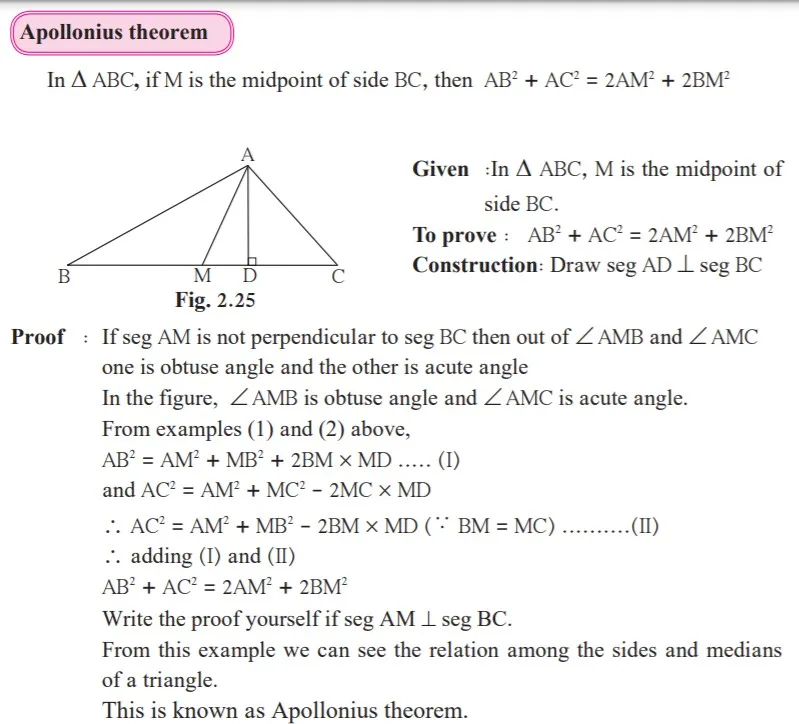
Answer: In \(\triangle ABC\), if D is the midpoint of BC, then \(AB^2 + AC^2 = 2AD^2 + 2BD^2\).
Statement (Apollonius theorem): In a triangle, the sum of the squares of any two sides equals twice the square of the median to the third side plus twice the square of half the third side.
Given: In \(\triangle ABC\), D is the midpoint of BC, so AD is a median and \(BD = DC\).
Construction: Draw \(AE \perp BC\), with E on line BC. (Take E between D and C; the other cases are similar.)
Proof: In right \(\triangle AEB\) and right \(\triangle AEC\), by Pythagoras' theorem,
\[AB^2 = AE^2 + BE^2 = AE^2 + (BD + DE)^2\]
\[AC^2 = AE^2 + EC^2 = AE^2 + (DC - DE)^2\]
Since \(DC = BD\), add the two equations:
\[AB^2 + AC^2 = 2AE^2 + 2BD^2 + 2DE^2\]
(the terms \(+2BD\cdot DE\) and \(-2BD\cdot DE\) cancel).
In right \(\triangle AED\), \(AE^2 + DE^2 = AD^2\). So
\[AB^2 + AC^2 = 2AD^2 + 2BD^2\]
Hence proved. Example: if \(PQ = 11\), \(PR = 17\), median \(PS = 13\), then \(410 = 338 + 2SR^2\), so \(SR = 6\) and \(QR = 12\).
Log in or create a free account to answer this question.