Chapter: Oscillations· Physics
Answer: For small angular displacement θ, the restoring torque on the magnet is \( \tau = -\mu B_h\theta \), so its angular acceleration \( \alpha = -\frac{\mu B_h}{I}\theta \) is proportional to θ and opposite to it. Hence the magnet performs angular S.H.M.
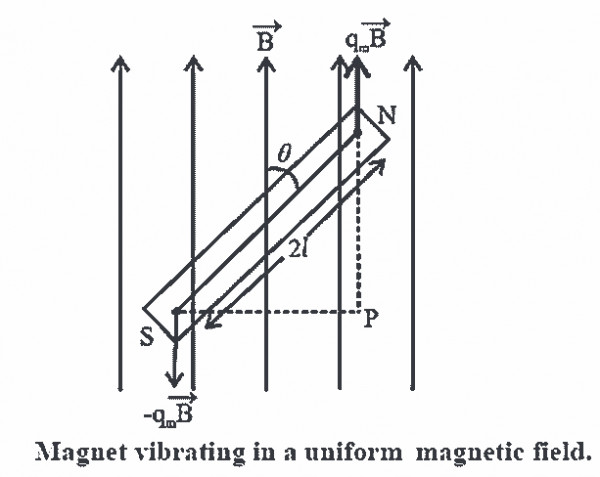
Consider a bar magnet of magnetic moment μ and moment of inertia I, suspended horizontally by a light twistless fibre in a region where the horizontal component of the Earth's magnetic field is Bh. The magnet is free to rotate in a horizontal plane and comes to rest along Bh (approximately North-South).
If it is turned in the horizontal plane through a small angle θ from its rest position (θ = 0) and released, it oscillates about the rest position.
The field Bh exerts a torque on the magnet which tends to bring it back parallel to Bh. This restoring torque is
\( \tau = -\mu B_h \sin\theta \)
The minus sign shows that the torque is opposite to the angular displacement. Condition: if θ is small, \( \sin\theta \approx \theta \) (in radian), so
\( \tau = -\mu B_h \theta \) ....(1)
But \( \tau = I\alpha \), where α is the angular acceleration.
∴ \( I\alpha = -\mu B_h\theta \) ⇒ \( \alpha = -\left(\frac{\mu B_h}{I}\right)\theta \) ....(2)
Since μ, Bh and I are constants, \( \alpha \propto -\theta \): the angular acceleration is directly proportional to the angular displacement and directed opposite to it. Hence, for small angular displacements (and a twistless suspension, uniform field), the oscillations of the magnet are angular S.H.M.
Comparing (2) with \( \alpha = -\omega^2\theta \): \( \omega = \sqrt{\frac{\mu B_h}{I}} \), so the period is \( T = 2\pi\sqrt{\frac{I}{\mu B_h}} \).