Skip to content
doubtly

2 answers

Best answer

The extent of corrosion depends upon the type of oxide film formed by metals. Oxide films formed are classified into three categories,
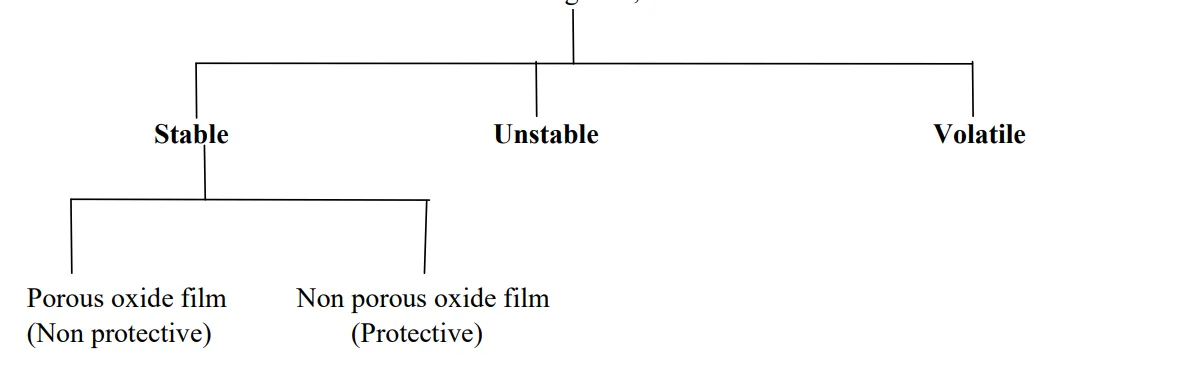
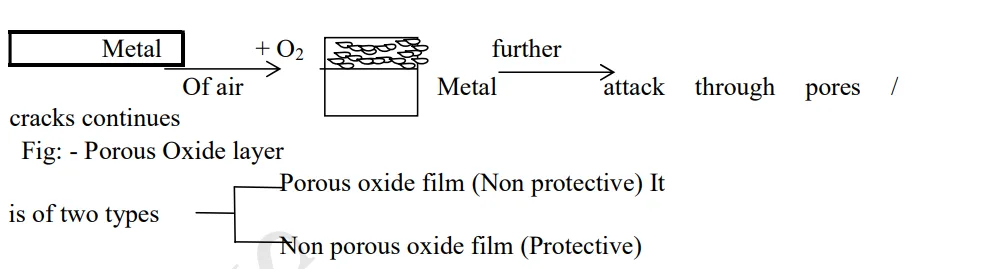
Stable Oxide film: A stable oxide film consists of fine grains in its structure & it can get adhered tightly to the metal surface 
Unstable Oxide film: - Where the oxide film formed is unstable & it decomposes back into metal & oxygen.  e.g. Oxides of metals like Gold, Silver, and Platinum etc. Hence metal forming unstable oxide film does not get covered.

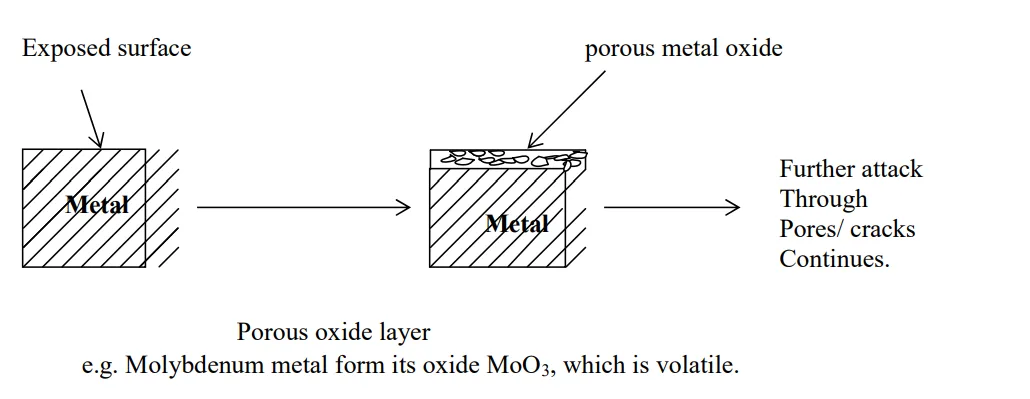
Volatile oxide film:- When the oxide film formed is volatile it vaporizes as soon as it is formed, the underlying metal surface is exposed for further attack of oxygen & thus causes continue & excessive corrosion. e.g. Molybdenum metal form its oxide MoO3, which is volatile
Doubtly · 13 Jun 2022 Report
Was this answer helpful?

Answer: The oxide film formed in oxidation (dry) corrosion can be stable, unstable, volatile or porous, and the type decides whether corrosion stops or continues.

  1. Stable (non-porous) film: fine-grained, compact and tightly adhering. It cuts off the metal from oxygen, so further corrosion stops; the film is protective. Examples: oxides of Al, Sn, Pb, Cu, Cr.
  2. Unstable film: the oxide decomposes back into metal and oxygen as soon as it forms, so the metal does not corrode. Examples: Ag, Au, Pt (noble metals).
  3. Volatile film: the oxide vaporises as soon as it forms, so fresh metal is exposed all the time and corrosion is rapid and continuous. Example: Mo forms volatile \(\mathrm{MoO_3}\).
  4. Porous film: the film has pores or cracks through which oxygen reaches the metal, so corrosion continues until the metal is used up. Examples: alkali and alkaline earth metals (Li, Na, K, Mg).

Pilling–Bedworth rule: if the volume of the oxide formed is less than the volume of the metal used, the film is porous and non-protective; if it is equal to or greater than the volume of the metal, the film is non-porous and protective.

Doubtly AI · 23 Oct 2026 AI-verified · Oct 2026 Report
Was this answer helpful?

Your answer

Log in or create a free account to answer this question.