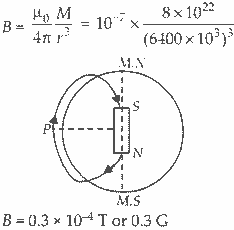
A dipole of moment \(8\times10^{22}\ \mathrm{J\,T^{-1}}\) at the earth's centre gives a surface field of about \(3\times10^{-5}\) T (0.3 G), the same order as the measured earth's field. So the value is reasonable.
Field at a point on the equatorial line of a short dipole, at distance \(R\) = radius of the earth:
\[B_E = \frac{\mu_0}{4\pi}\,\frac{m}{R^3}\]
Take \(\mu_0/4\pi = 10^{-7}\ \mathrm{T\,m\,A^{-1}}\), \(m = 8\times10^{22}\ \mathrm{J\,T^{-1}}\), \(R = 6.4\times10^{6}\) m:
\[R^3 = 2.62\times10^{20}\ \mathrm{m^3}\]
\[B_E = \frac{10^{-7}\times 8\times10^{22}}{2.62\times10^{20}}\]
\[B_E \approx 3.05\times10^{-5}\ \mathrm{T} \approx 0.3\ \mathrm{G}\]
The observed earth's field at the surface is about 0.3 to 0.6 G (\(3\)–\(6\times10^{-5}\) T). The calculated value has the same order of magnitude, so the dipole moment \(8\times10^{22}\ \mathrm{J\,T^{-1}}\) is of the right order.