Skip to content
doubtly

2 answers

Best answer

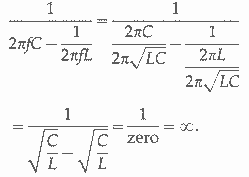
Answer: Natural frequency \(f_0 = \frac{1}{2\pi\sqrt{LC}}\); the net reactance of the circuit at this frequency is zero.

In an LC circuit, the inductive reactance is \(X_L = \omega L\) and the capacitive reactance is \(X_C = \frac{1}{\omega C}\).

The natural (resonant) frequency is the frequency at which these two are equal:

\(\omega_0 L = \frac{1}{\omega_0 C} \Rightarrow \omega_0 = \frac{1}{\sqrt{LC}}\), so \(f_0 = \frac{1}{2\pi\sqrt{LC}}\)

where L is the inductance and C is the capacitance.

At this frequency \(X_L = X_C\), and since they act in opposite senses, the net reactance is

\(X = X_L - X_C = 0\)

So the reactance of the circuit at its natural frequency is zero. (In a series LCR circuit the impedance then becomes equal to R, its minimum value, and the current is maximum.)
Radhika · 1 Nov 2022 Report
Was this answer helpful?

Answer: Natural frequency \(f_0 = \dfrac{1}{2\pi\sqrt{LC}}\); at this frequency the net reactance of the series LC circuit is zero.

The inductive and capacitive reactances are

\[X_L = 2\pi f L,\quad X_C = \frac{1}{2\pi f C}\]

The natural (resonant) frequency is the frequency at which they are equal:

\[2\pi f_0 L = \frac{1}{2\pi f_0 C} \Rightarrow f_0 = \frac{1}{2\pi\sqrt{LC}}\]

(In terms of angular frequency, \(\omega_0 = 1/\sqrt{LC}\).)

In a series circuit the net reactance is \(X = X_L - X_C\). At \(f_0\), \(X_L = X_C\), so

\[X = 0.\]

The voltages across L and C are equal and opposite and cancel, so the impedance is just the resistance R of the circuit, and the current is maximum.

Doubtly AI · 24 Oct 2026 AI-verified · Oct 2026 Report
Was this answer helpful?

Practise this chapter

AC Circuits

Take a 10-question test new questions each time · marked instantly · free

Your answer

Log in or create a free account to answer this question.