
Linear Regression
On this page
What is Linear Regression?
Linear Regression is a machine learning algorithm it is used for predicting Dependent variable based on independent variables. Equation:- y=w*X+b
How Linear Regression work?
Linear regression is based on concept of line. Equation of line is y=m*x+c, where m is slope and c is constant in machine learning we call them weight(w) and bias(b) respectively, y and x are dependent and independent variable respectively. So now based on x we can predict y. Example:- if x=2 then y=m*2+c. (Independent variable is always present in question statement).
How to find values of m, c?
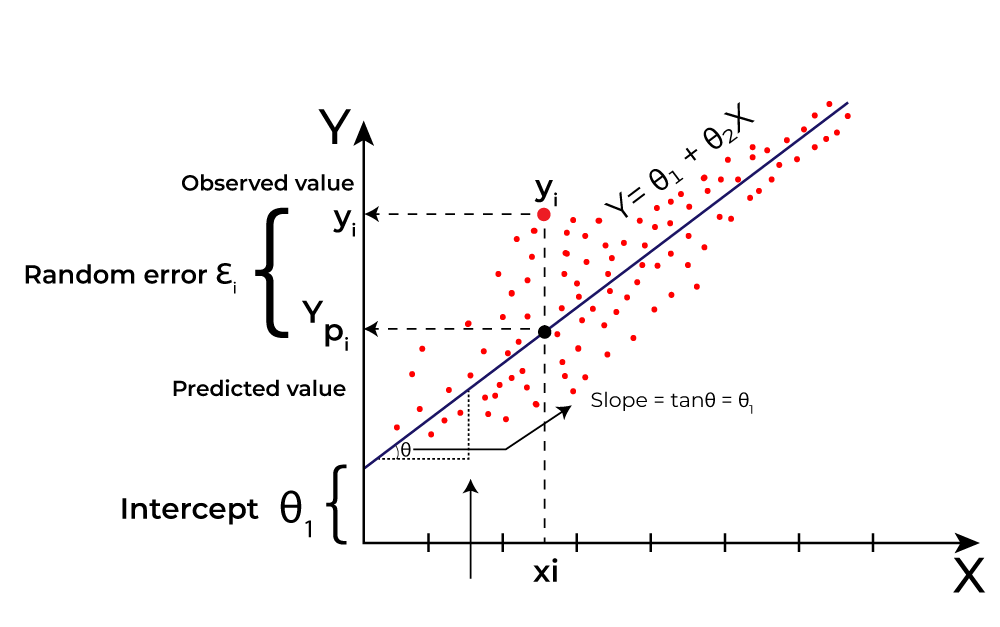
To answer this question we will fit a line on a dataset.
Step 1:-
Initialize W and b at random. For this purpose you can use numpy.random.randn() or similar other functions like zeros(),ones(), rand() present in Numpy Library. or you can use functions from Tensorflow.
weights = np.zeros((1,1))
bias = 0
Step 2:-
perform forward prop using W and b.
Forward Prop:-
y=w*X+b
# code for forward prop:-
y_pred=W*X+b
Step 3:-
Calculate loss function:-
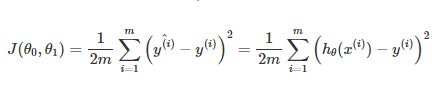
cost=1/(2*m)*np.sum(np.square(y_pred-Y)) # Y is actual value of Independent variable were as y_pred value is predicted value of Independent value variable using forward prop.Step 4:-
Find dw and db
dw and db are slope of cost function with respect to w and b
reduce dw and db from w and b at a certain called as learning rate (lr). this step is known as Back-prop
#Code for dw and db
dw=(1/m)*np.sum(X*y_pred-Y)
db=(1/m)*np.sum(y_pred-Y)
W = W - lr * dw
b = b - lr * db
Step 5:-
Repeat step 2 and step 4 till cost function is not almost zero and there you have perfect values of W and b.
Predict:-
y_pred = np.dot(X, W) + bCode For LinearRegression Model:-
class LinearRegression:

    def __init__(self, lr=0.0001, n_iters=100):
        self.lr = lr
        self.n_iters = n_iters
        self.weights = None
        self.bias = None

    def fit(self, X, y):
        n_samples, n_features = X.shape
        self.weights = np.zeros((1,1))
        self.bias = 0

        for _ in range(self.n_iters):
            y_pred = np.dot(X, self.weights) + self.bias
            print(1/(2*25000)*np.sum(np.square(y_pred-Y)))
            dw = (1/n_samples) * np.dot(X.T, (y_pred-y))
            db = (1/n_samples) * np.sum(y_pred-y)
            print(dw.shape)
            print(db.shape)
            self.weights = self.weights - self.lr * dw
            self.bias = self.bias - self.lr * db

    def predict(self, X):
        y_pred = np.dot(X, self.weights) + self.bias
        return y_pred
After adding Sigmoid activation you can modify linear Regression to logistic Regression.
Thankyou!!
More in Unacategorized
See all →- Graph Theory Explained – SMA Welcome to Graph Theory! Graphs are fundamental structures used to model relationships between objects. They are made up of: Nodes (or Verti...
- Reinforcement Learning Viva Questions & Answer – MU AI & DS Semester 8 1 Introduction to Reinforcement Learning (4 Hours) Key features and Elements of RL Types of RL Rewards Reinforcement Learning Algorithms: Q-...
- Ensemble Learning Visualizer This interactive tool helps visualize how different ensemble learning methods work. Select a method below to explore step-by-step: Bagging:...
- Important Topics for Semester 3 Exam [CS/AI-DS/AI-ML/CSE] Important Topics for Semester 3 Exam [CS/AI-DS/AI-ML/CSE] MATHS-3 Laplace Transform (L) of standard functions First Shifting Theorem and Sec...
- NLP MOdule 4,5,6 PYQ Module 4: Semantic Analysis Questions: What is Word Sense Disambiguation (WSD)? Explain the dictionary based approach to Word Sense Disambig...
- What is the output of the following code? Integer p, q, r Set p=1, q=4, r=6 for (each r from 5 to 9 ) if(7< p && (4&r)