Converting to clauses and resolving with the negated goal gives the empty clause, so "Someone is smiling" is proved.
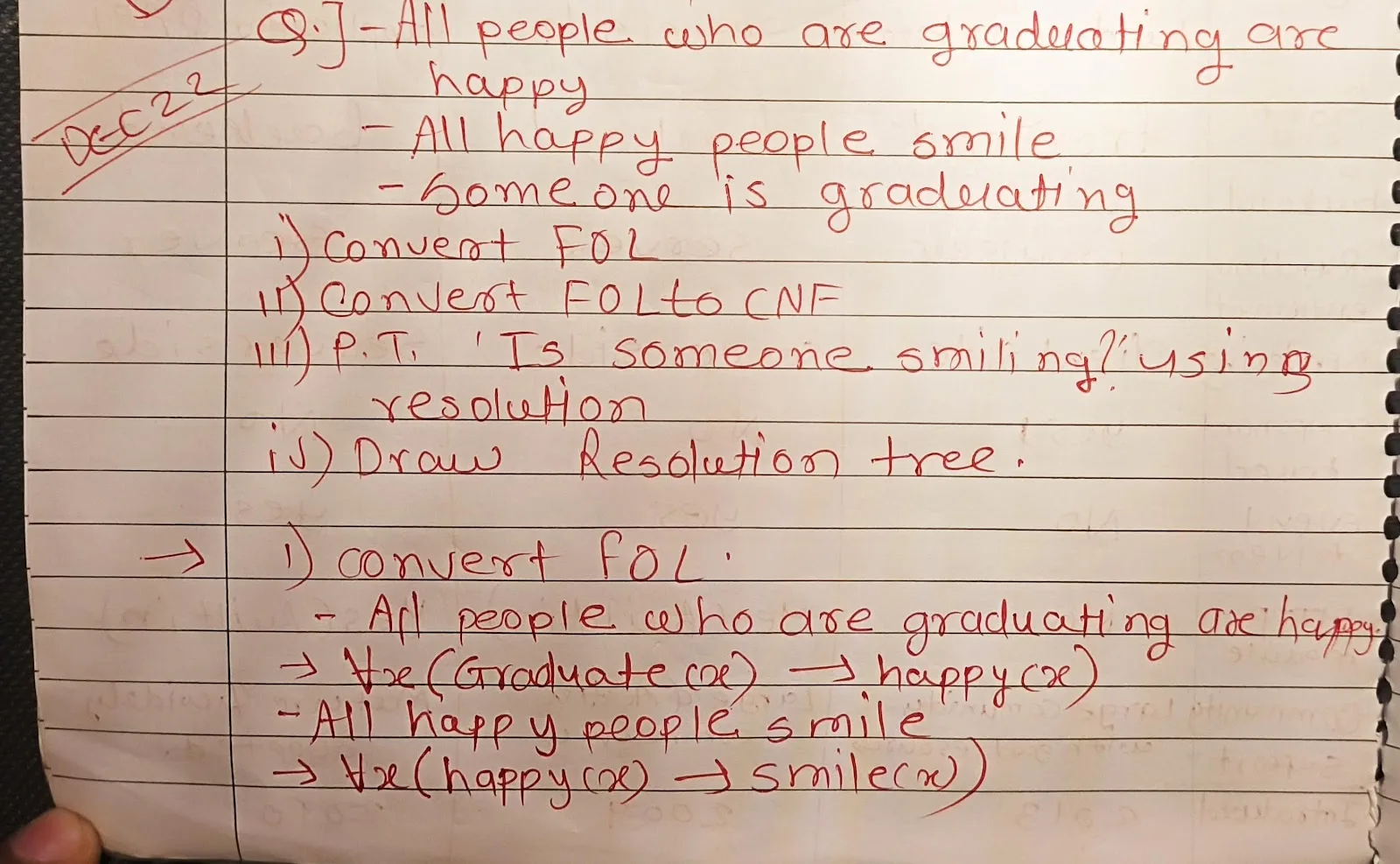
Step 1: Predicate logic
- \(\forall x\, (\text{Graduating}(x) \rightarrow \text{Happy}(x))\)
- \(\forall x\, (\text{Happy}(x) \rightarrow \text{Smile}(x))\)
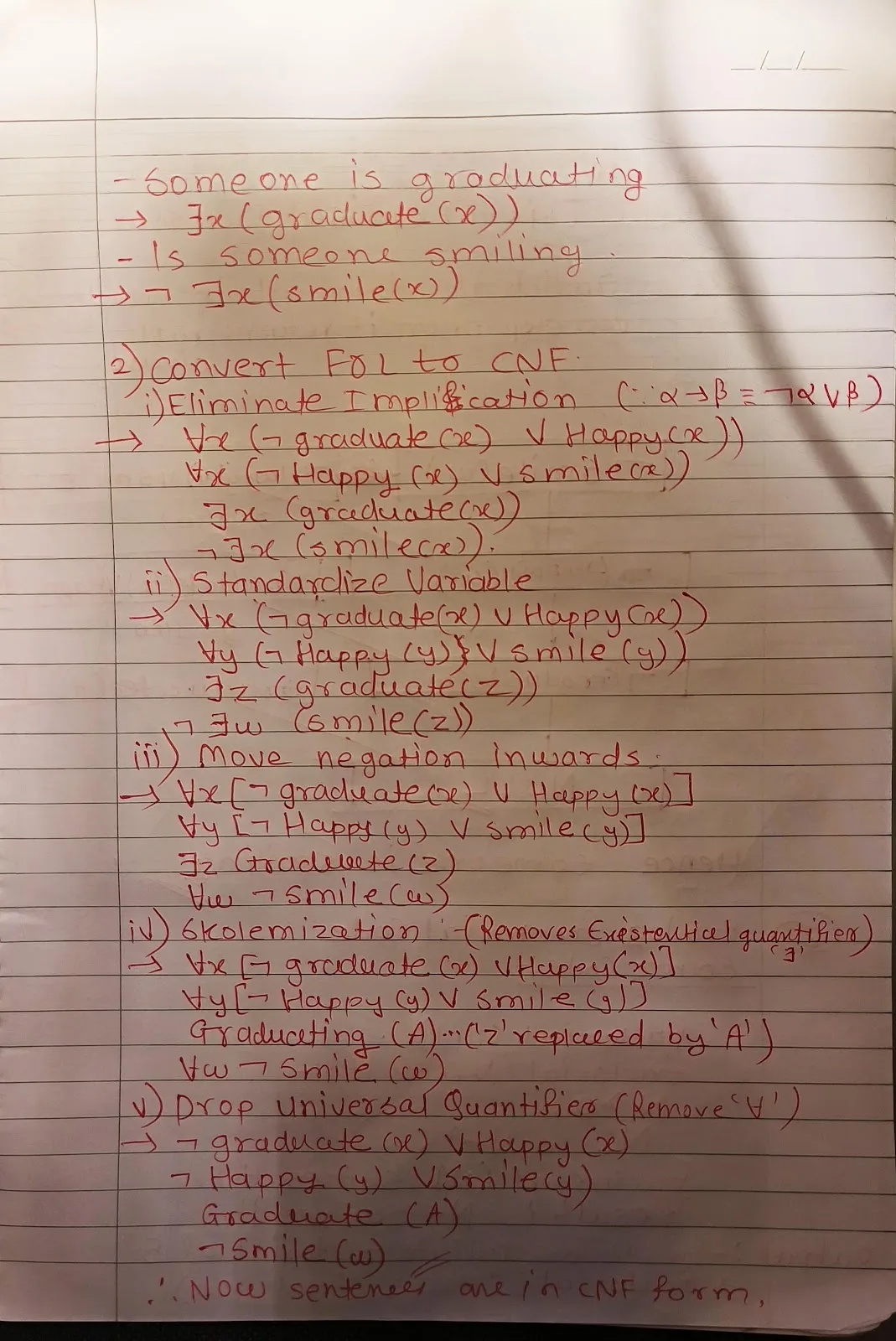
- \(\exists x\, \text{Graduating}(x)\)
- Goal: \(\exists x\, \text{Smile}(x)\)
Step 2: Clause form (CNF)
- \(\neg \text{Graduating}(x) \lor \text{Happy}(x)\)
- \(\neg \text{Happy}(y) \lor \text{Smile}(y)\)
- \(\text{Graduating}(A)\) (A is a Skolem constant for "someone")
- Negated goal: \(\neg \exists z\, \text{Smile}(z)\) becomes \(\neg \text{Smile}(z)\)
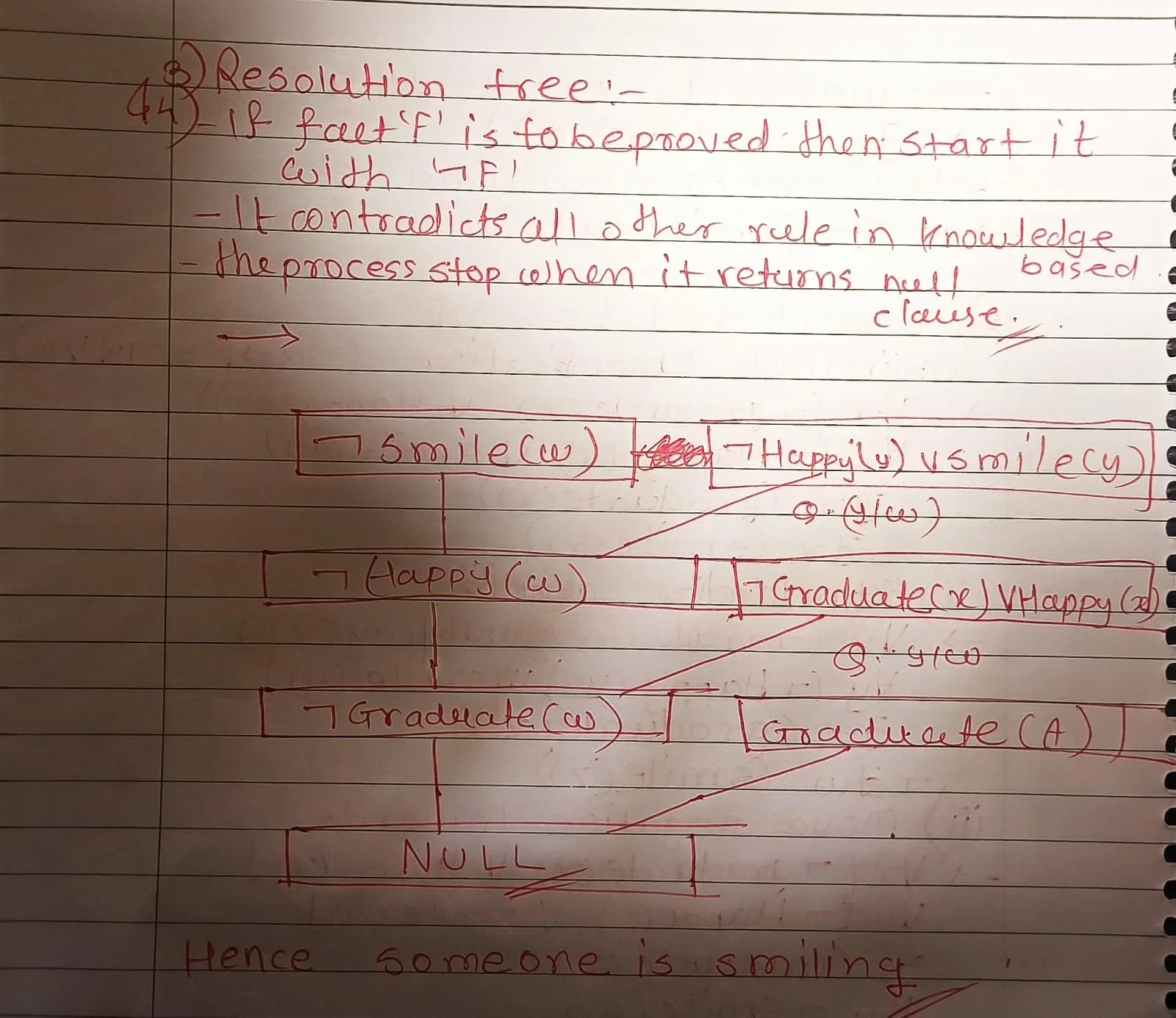
Step 3: Resolution tree
¬Smile(z)        ¬Happy(y) ∨ Smile(y)
        \        /   {y/z}
        ¬Happy(z)        ¬Graduating(x) ∨ Happy(x)
              \          /   {x/z}
          ¬Graduating(z)        Graduating(A)
                   \            /   {z/A}
                       NIL (empty clause)
Resolving clause 4 with 2 gives \(\neg \text{Happy}(z)\); with 1 gives \(\neg \text{Graduating}(z)\); with 3 (substituting \(z = A\)) gives the empty clause. The contradiction shows the negated goal is false, so "someone is smiling" is true: A is smiling.