Skip to content
doubtly
Topic: Capacitors, series and parallel combination, parallel plate capacitor with/without dielectric· Electrostatics

A parallel-plate capacitor of area A, plate separation d and capacitance C is filled with four dielectric materials having dielectric constants k_1,k_2,k_3 and k_4 as shown in the figure below. If a single dielectric material is to be used to have th…

A parallel-plate capacitor of area \(A\), plate separation \(d\) and capacitance \(C\) is filled with four dielectric materials having dielectric constants \(k_1,k_2,k_3\) and \(k_4\) as shown in the figure below. If a single dielectric material is to be used to have the same capacitance \(C\) in this capacitor, then its dielectric constant \(k\) is given by
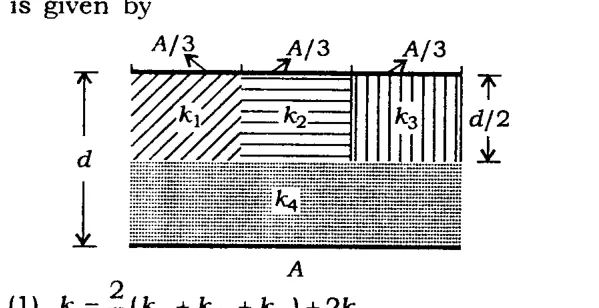
capacitor with dielectrics k1,k2,k3 (each area A/3, thickness d/2) over k4

1. \(k=\frac{2}{3}(k_1+k_2+k_3)+2k_4\)

2. \(\frac{2}{k}=\frac{3}{k_1+k_2+k_3}+\frac{1}{k_4}\)

3. \(\frac{1}{k}=\frac{1}{k_1}+\frac{1}{k_2}+\frac{1}{k_3}+\frac{3}{2k_4}\)

4. \(k=k_1+k_2+k_3+3k_4\)

1 answer

Best answer

Answer: 2. \(\frac{2}{k}=\frac{3}{k_1+k_2+k_3}+\frac{1}{k_4}\)

The upper half (thickness \(d/2\)) has three dielectrics side by side, each of area \(A/3\), so they are in parallel; this combination is in series with the lower dielectric \(k_4\) of thickness \(d/2\).

  • Top: \(C_{top}=\dfrac{\varepsilon_0A}{3(d/2)}(k_1+k_2+k_3)=\dfrac{2\varepsilon_0A}{3d}(k_1+k_2+k_3)\).
  • Bottom: \(C_4=\dfrac{\varepsilon_0Ak_4}{d/2}=\dfrac{2\varepsilon_0Ak_4}{d}\).

Single dielectric \(k\): \(C=\dfrac{k\varepsilon_0A}{d}\). Series: \(\dfrac1C=\dfrac1{C_{top}}+\dfrac1{C_4}\):

$$\frac{1}{k}=\frac{3}{2(k_1+k_2+k_3)}+\frac{1}{2k_4}\ \Rightarrow\ \frac2k=\frac{3}{k_1+k_2+k_3}+\frac1{k_4}$$

Option (2).

Doubtly AI · 30 Oct 2026 AI-generated · not yet verified Report
Was this answer helpful?

Your answer

Log in or create a free account to answer this question.