Skip to content
doubtly
Topic: Isothermal and adiabatic processes· Thermodynamics

Thermodynamic processes are indicated in the following diagram.Match the following :Column-1: P. Process I; Q. Process II; R. Process III; S. Process IVColumn-2: a. Adiabatic; b. Isobaric; c. Isochoric; d. Isothermal

Thermodynamic processes are indicated in the following diagram.

Match the following :

Column-1: P. Process I; Q. Process II; R. Process III; S. Process IV

Column-2: a. Adiabatic; b. Isobaric; c. Isochoric; d. Isothermal
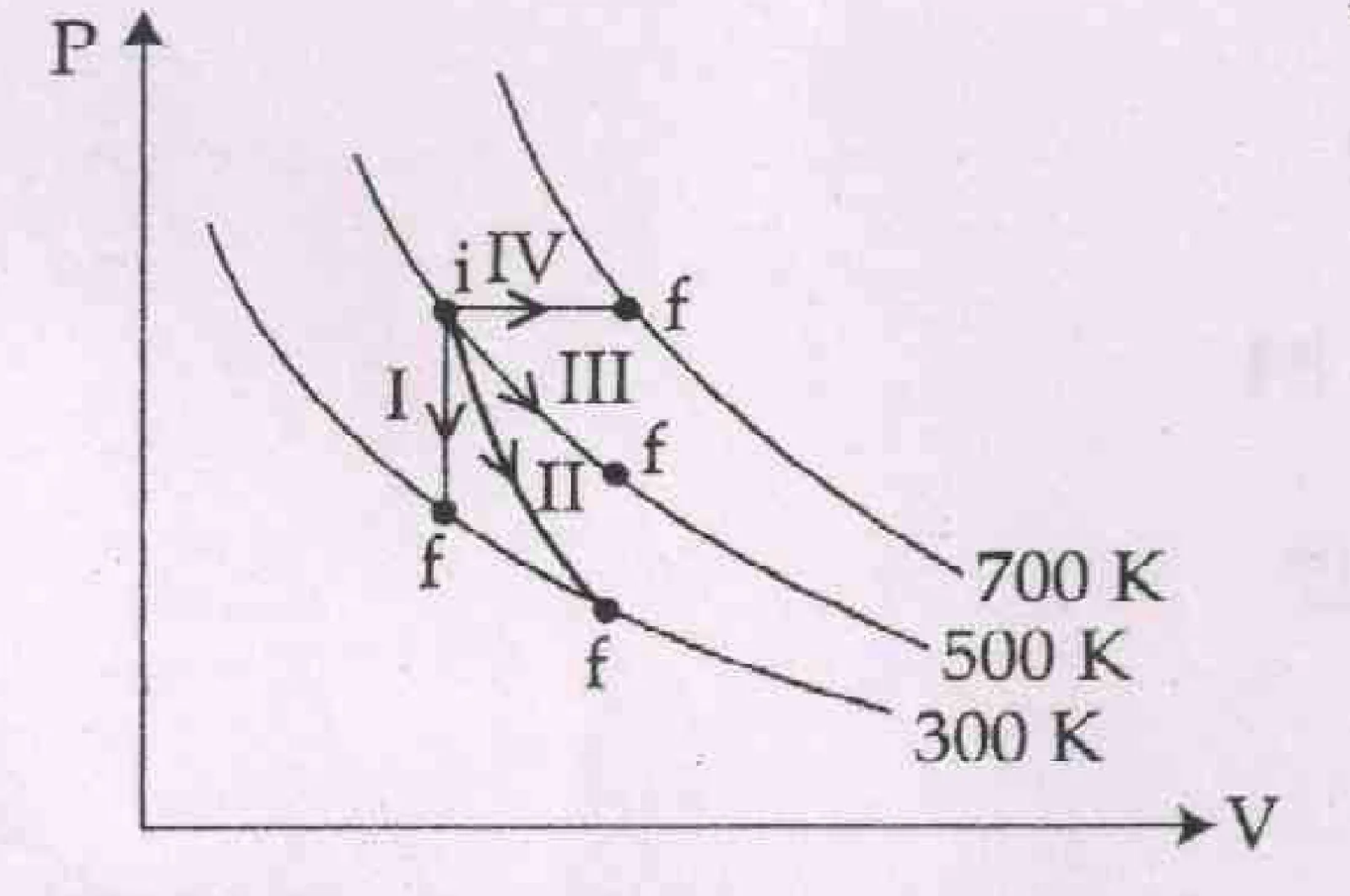
P-V diagram with processes I-IV and isotherms 300 K, 500 K, 700 K

1. P\(\to\)c, Q\(\to\)a, R\(\to\)d, S\(\to\)b

2. P\(\to\)c, Q\(\to\)d, R\(\to\)b, S\(\to\)a

3. P\(\to\)d, Q\(\to\)b, R\(\to\)a, S\(\to\)c

4. P\(\to\)a, Q\(\to\)c, R\(\to\)d, S\(\to\)b

1 answer

Best answer

Answer: 1. P\(\to\)c, Q\(\to\)a, R\(\to\)d, S\(\to\)b

Key idea: identify each process from the P-V diagram.

  • I: vertical line, volume constant, isochoric (c).
  • II: steep curve from the 500 K isotherm to the 300 K isotherm, steeper than an isotherm: adiabatic (a).
  • III: follows the 500 K curve, temperature constant: isothermal (d).
  • IV: horizontal line, pressure constant: isobaric (b).

So P to c, Q to a, R to d, S to b.

Doubtly AI · 30 Oct 2026 AI-generated · not yet verified Report
Was this answer helpful?

Your answer

Log in or create a free account to answer this question.