Skip to content
doubtly
Topic: Self and mutual inductance· Electromagnetic Induction and Alternating Currents

Figure shows a circuit that contains three identical resistors with resistance R = 9.0 Ω each, two identical inductors with inductance L = 2.0 mH each, and an ideal battery with emf ε = 18 V. The current 'i' through the battery just after the switch…

Figure shows a circuit that contains three identical resistors with resistance R = 9.0 \(\Omega\) each, two identical inductors with inductance L = 2.0 mH each, and an ideal battery with emf \(\varepsilon\) = 18 V. The current 'i' through the battery just after the switch closed is,.....
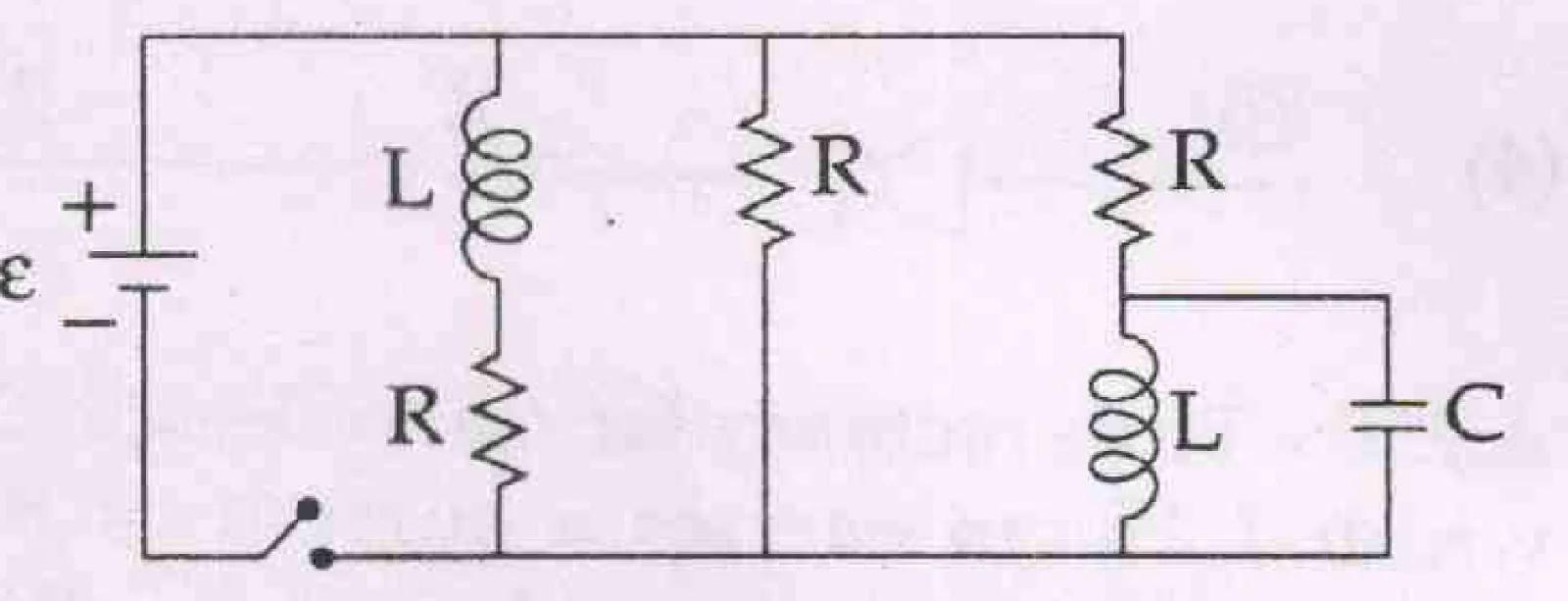
circuit with battery, switch, inductors L, resistors R and a capacitor C

1. 0.2 A

2. 2 A

3. 0 ampere

4. 2 mA

Doubtly Asked Updated NEET UG 2017 neet Save WhatsApp Report

1 answer

Best answer

Correct option: (2) 2 A

Key idea: the current through an inductor cannot change suddenly. Just after the switch is closed, the current in each inductor is still zero, so each inductor acts like an open circuit.

  1. Two of the resistors are in series with the inductors. At \(t = 0\) no current flows in those branches.
  2. Current flows only through the branch that has a single resistor \(R = 9.0\ \Omega\) directly across the battery.
  3. So the current through the battery is \[ i = \frac{\varepsilon}{R} = \frac{18}{9.0} = 2\ \text{A} \]

The inductance value (2.0 mH) does not matter at the instant the switch closes. It only sets how quickly the current in the inductor branches builds up later.

Doubtly AI · 31 Oct 2026 AI-verified · Nov 2026 Report
Was this answer helpful?

Practise this chapter

Electromagnetic Induction and Alternating Currents

Take the chapter test 17 questions · 17 min · free

Your answer

Log in or create a free account to answer this question.