Skip to content
doubtly
Topic: Kepler's laws of planetary motion· Gravitation

The kinetic energies of a planet in an elliptical orbit about the Sun, at positions A, B and C are K_A, K_B and K_C, respectively. AC is the major axis and SB is perpendicular to AC at the position of the Sun S as shown in the figure. Then
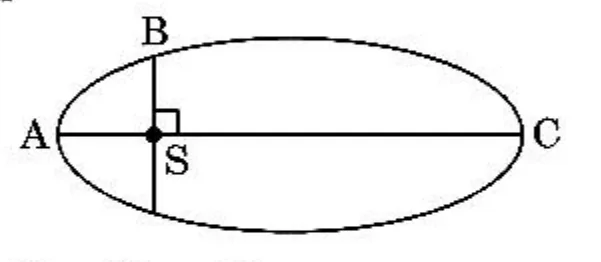
The kinetic energies of a planet in an elliptical orbit about the Sun, at positions A, B and C are \(K_A\), \(K_B\) and \(K_C\), respectively. AC is the major axis and SB is perpendicular to AC at the position of the Sun S as shown in the figure. Then

elliptical orbit with A,B,C,S

1. \(K_A<K_B<K_C\)

2. \(K_B<K_A<K_C\)

3. \(K_A>K_B>K_C\)

4. \(K_B>K_A>K_C\)

1 answer

Best answer

Answer: 3. \(K_A>K_B>K_C\)

By conservation of angular momentum (Kepler's second law), a planet moves faster when it is closer to the Sun, so its kinetic energy is greater there.

From the figure, A is the point closest to the Sun S (perihelion), C is the farthest (aphelion), and B lies in between: \(SB\) (the semi-latus rectum) is longer than \(SA\) but shorter than \(SC\).

So \(K_A>K_B>K_C\).

Doubtly AI · 30 Oct 2026 AI-generated · not yet verified Report
Was this answer helpful?

Your answer

Log in or create a free account to answer this question.