Skip to content
doubtly
Topic: Ampere's law: straight wire and solenoid· Magnetic Effects of Current and Magnetism

A cylindrical conductor of radius R is carrying a constant current. The plot of the magnitude of the magnetic field, B with the distance, d, from the centre of the conductor, is correctly represented by the figure :
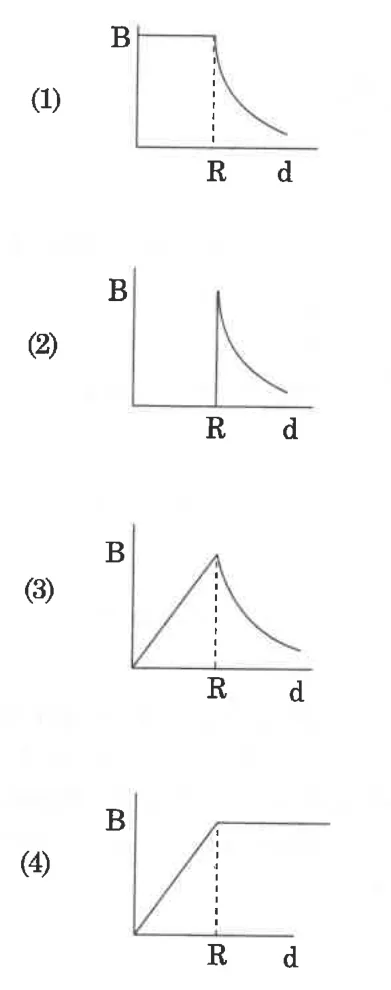
A cylindrical conductor of radius R is carrying a constant current. The plot of the magnitude of the magnetic field, B with the distance, d, from the centre of the conductor, is correctly represented by the figure :

four B vs d graphs (options 1-4)

1. [graph] B constant (flat) for d < R, then decreasing for d > R

2. [graph] B zero for d < R, jumps to maximum at R then decreasing for d > R

3. [graph] B increasing linearly for d < R, peak at R, then decreasing for d > R

4. [graph] B increasing linearly for d < R, then constant for d > R

Doubtly Asked Updated NEET UG 2019 Practice test neet Save WhatsApp Report

1 answer

Best answer

Correct option: (3) B increases linearly for \(d<R\), is maximum at \(d=R\), then decreases for \(d>R\)

Apply Ampere's circuital law to a circle of radius \(d\) coaxial with the conductor (current \(I\) spread uniformly over the cross-section).

  • Inside (\(d<R\)): current enclosed \(=I\dfrac{d^2}{R^2}\). So \(B\cdot2\pi d=\mu_0I\dfrac{d^2}{R^2}\), giving \(B=\dfrac{\mu_0Id}{2\pi R^2}\propto d\): a straight line from the origin.
  • Outside (\(d>R\)): the whole current is enclosed, so \(B=\dfrac{\mu_0I}{2\pi d}\propto\dfrac1d\): it falls off.

Both expressions give \(B=\dfrac{\mu_0I}{2\pi R}\) at \(d=R\), which is the maximum. The graph rising linearly up to \(R\) and then decreasing is graph 3.

Doubtly AI · 30 Oct 2026 AI-verified · Nov 2026 Report
Was this answer helpful?

Your answer

Log in or create a free account to answer this question.