
Topic: Ampere's law: straight wire and solenoid· Magnetic Effects of Current and Magnetism
A thick current carrying cable of radius 'R' carries current 'I' uniformly distributed across its cross-section. The variation of magnetic field B(r) due to the cable with the distance 'r' from the axis of the cable is represented by :
A thick current carrying cable of radius 'R' carries current 'I' uniformly distributed across its cross-section. The variation of magnetic field B(r) due to the cable with the distance 'r' from the axis of the cable is represented by :
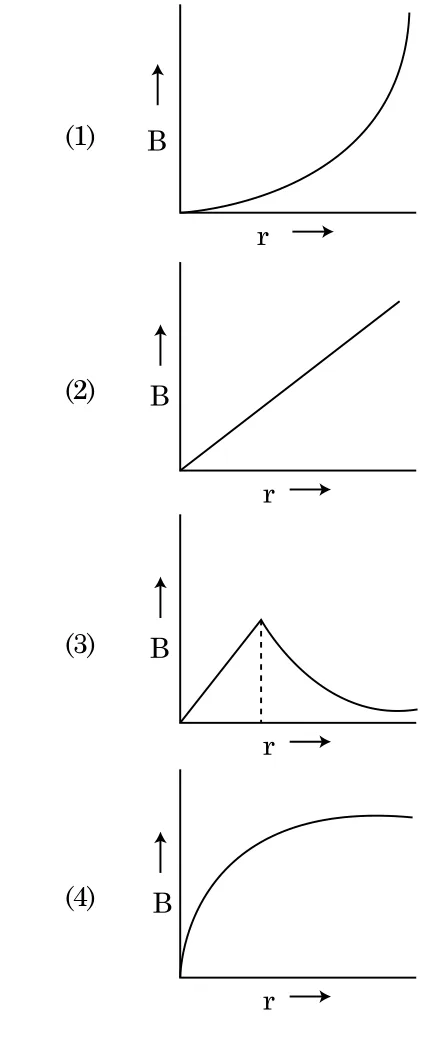
1. Graph (1): B vs r, curve rising from origin, concave up, increasing steeply
2. Graph (2): B vs r, straight line from origin
3. Graph (3): B vs r, linear rise to a peak then decreasing
4. Graph (4): B vs r, curve rising steeply then flattening