Skip to content
doubtly
Topic: Alkenes: ozonolysis and polymerization· Hydrocarbons

An alkene "A" on reaction with O_3 and Zn-H_2O gives propanone and ethanal in equimolar ratio. Addition of HCl to alkene "A" gives "B" as the major product. The structure of product "B" is :
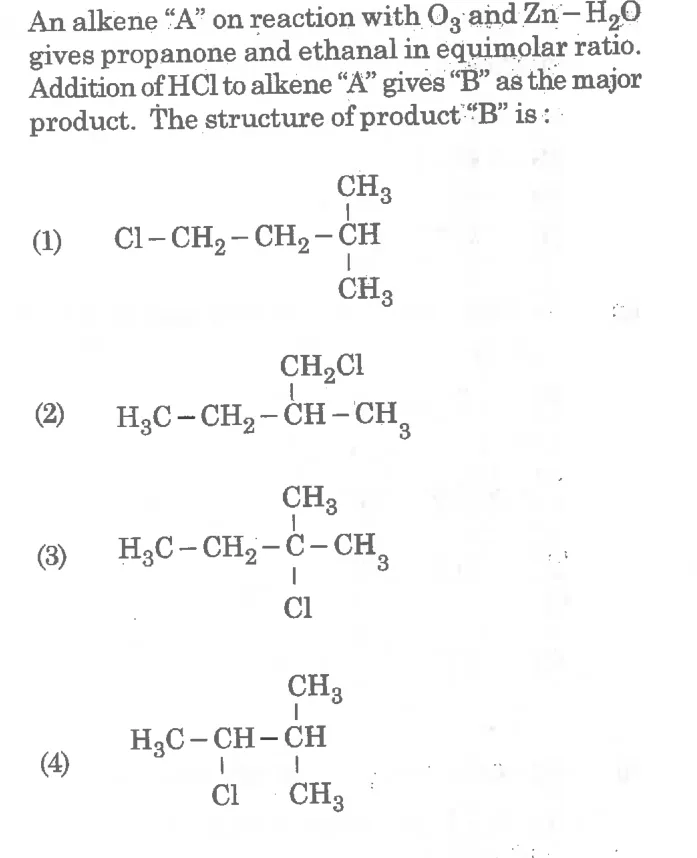
An alkene "A" on reaction with O\(_3\) and Zn-H\(_2\)O gives propanone and ethanal in equimolar ratio. Addition of HCl to alkene "A" gives "B" as the major product. The structure of product "B" is :

four structural formulas as options

1. Cl-CH\(_2\)-CH\(_2\)-CH(CH\(_3\))-CH\(_3\) (see figure)

2. H\(_3\)C-CH\(_2\)-CH(CH\(_2\)Cl)-CH\(_3\) (see figure)

3. H\(_3\)C-CH\(_2\)-C(CH\(_3\))(Cl)-CH\(_3\) (see figure)

4. H\(_3\)C-CH(Cl)-CH(CH\(_3\))-CH\(_3\) (see figure)

1 answer

Best answer

Answer: 3. H\(_3\)C-CH\(_2\)-C(CH\(_3\))(Cl)-CH\(_3\) (see figure)

Work back from the ozonolysis products. Propanone \(\mathrm{(CH_3)_2C=O}\) and ethanal \(\mathrm{CH_3CHO}\) join at the double bond to give alkene A = \(\mathrm{(CH_3)_2C=CHCH_3}\) (2-methylbut-2-ene).

HCl adds by Markovnikov's rule: H goes to the carbon with more hydrogens (\(\mathrm{CHCH_3}\)) and Cl to the tertiary carbon, giving the more stable tertiary carbocation.

B = \(\mathrm{CH_3CH_2C(CH_3)_2Cl}\) (2-chloro-2-methylbutane), option (3).

Doubtly AI · 30 Oct 2026 AI-generated · not yet verified Report
Was this answer helpful?

Your answer

Log in or create a free account to answer this question.