Skip to content
doubtly
Topic: Refraction at plane and spherical surfaces, thin lens and lens maker formula· Optics

A point object is placed at a distance of 60 cm from a convex lens of focal length 30 cm. If a plane mirror were put perpendicular to the principal axis of the lens and at a distance of 40 cm from it, the final image would be formed at a distance of…

A point object is placed at a distance of 60 cm from a convex lens of focal length 30 cm. If a plane mirror were put perpendicular to the principal axis of the lens and at a distance of 40 cm from it, the final image would be formed at a distance of :
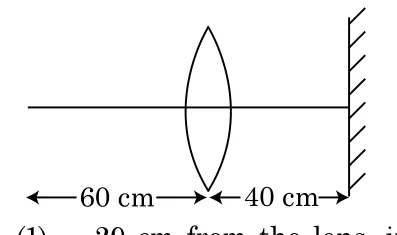
convex lens with plane mirror 40 cm behind it, object 60 cm in front

1. 20 cm from the lens, it would be a real image.

2. 30 cm from the lens, it would be a real image.

3. 30 cm from the plane mirror, it would be a virtual image.

4. 20 cm from the plane mirror, it would be a virtual image.

1 answer

Best answer

Answer: 4. 20 cm from the plane mirror, it would be a virtual image.

Key idea: lens, then mirror, then lens again.

  1. Lens: \(u=-60,\ f=30\Rightarrow v=60\) cm, image would form 20 cm behind the mirror (mirror at 40 cm).
  2. The mirror reflects the converging rays; the image forms 20 cm in front of the mirror, i.e. 20 cm from the lens (a real image there).
  3. This image acts as an object for the lens at 20 cm (inside the focal length), with light going back through the lens: \(\dfrac1v=\dfrac1{30}-\dfrac1{20}=-\dfrac1{60}\Rightarrow v=-60\) cm. A virtual image 60 cm from the lens on the mirror side.

That is 20 cm beyond (behind) the mirror, i.e. 20 cm from the mirror and virtual. Option 4.

Doubtly AI · 30 Oct 2026 AI-generated · not yet verified Report
Was this answer helpful?

Your answer

Log in or create a free account to answer this question.