Skip to content
doubtly
Topic: Energy stored in a capacitor· Electrostatics

A capacitor of capacitance C = 900 pF is charged fully by 100 V battery B as shown in figure (a). Then it is disconnected from the battery and connected to another uncharged capacitor of capacitance C = 900 pF as shown in figure (b). The electrostati…

A capacitor of capacitance C = 900 pF is charged fully by 100 V battery B as shown in figure (a). Then it is disconnected from the battery and connected to another uncharged capacitor of capacitance C = 900 pF as shown in figure (b). The electrostatic energy stored by the system (b) is :
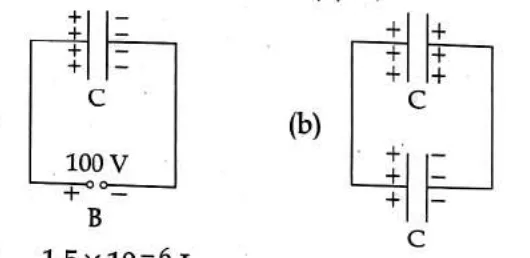
figures (a) capacitor with 100 V battery B, (b) two capacitors connected

1. \(1.5 \times 10^{-6}\) J

2. \(4.5 \times 10^{-6}\) J

3. \(3.25 \times 10^{-6}\) J

4. \(2.25 \times 10^{-6}\) J

1 answer

Best answer

Answer: 4. \(2.25 \times 10^{-6}\) J

Initial charge: \(Q=CV=900\times10^{-12}\times100=9\times10^{-8}\ \text{C}\).

After connecting to an identical uncharged capacitor, charge is conserved and the voltage is shared: \(V'=\dfrac{Q}{2C}=50\ \text{V}\).

\(U=\tfrac12(2C)V'^2=\tfrac12\times1800\times10^{-12}\times2500=2.25\times10^{-6}\ \text{J}\)

Option (4). Half of the original energy \(4.5\times10^{-6}\) J is lost as heat and radiation.

Doubtly AI · 30 Oct 2026 AI-generated · not yet verified Report
Was this answer helpful?

Your answer

Log in or create a free account to answer this question.