Skip to content
doubtly
Topic: Ethers· Organic Compounds Containing Oxygen

Consider the following reaction :C_6H_5-CH_2-O-C_6H_5 [Δ]HI A + B (benzyl phenyl ether)Identify products A and B.

Consider the following reaction :

\(\mathrm{C_6H_5-CH_2-O-C_6H_5 \xrightarrow[\Delta]{HI} A + B}\) (benzyl phenyl ether)

Identify products A and B.
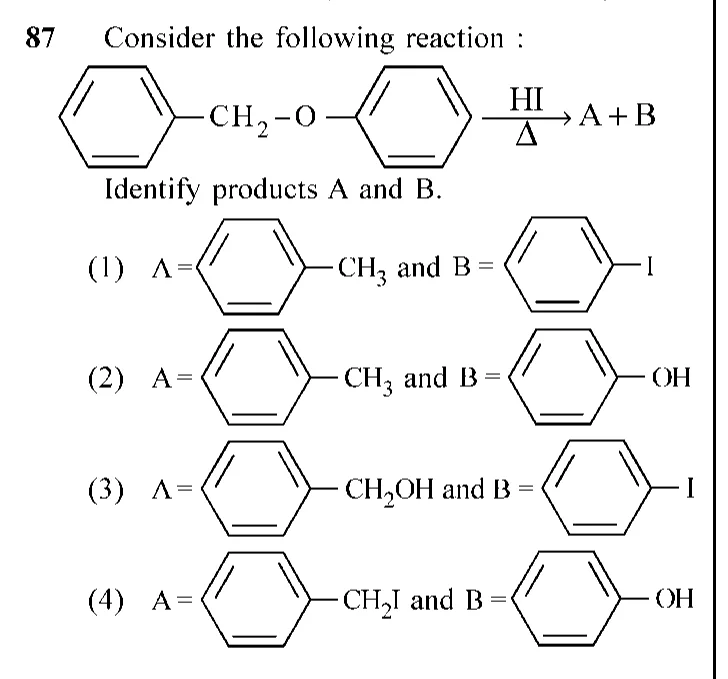
reaction and four options with benzene-ring structures

1. A = C\(_6\)H\(_5\)-CH\(_3\) and B = C\(_6\)H\(_5\)-I (iodobenzene)

2. A = C\(_6\)H\(_5\)-CH\(_3\) and B = C\(_6\)H\(_5\)-OH

3. A = C\(_6\)H\(_5\)-CH\(_2\)OH and B = C\(_6\)H\(_5\)-I

4. A = C\(_6\)H\(_5\)-CH\(_2\)I and B = C\(_6\)H\(_5\)-OH

1 answer

Best answer

Answer: 4. A = C\(_6\)H\(_5\)-CH\(_2\)I and B = C\(_6\)H\(_5\)-OH

Key idea: HI cleaves an aryl alkyl ether at the alkyl-oxygen bond, because the aryl C-O bond has partial double-bond character.

\(\mathrm{C_6H_5CH_2-O-C_6H_5 + HI \rightarrow C_6H_5CH_2I + C_6H_5OH}\)

A is benzyl iodide and B is phenol. Option 4. Iodobenzene is not formed because nucleophilic attack on the sp\(^2\) ring carbon is not possible.

Doubtly AI · 30 Oct 2026 AI-generated · not yet verified Report
Was this answer helpful?

Your answer

Log in or create a free account to answer this question.