
Topic: Surface energy, surface tension, angle of contact, excess pressure, drops, bubbles, capillary rise· Properties of Solids and Liquids
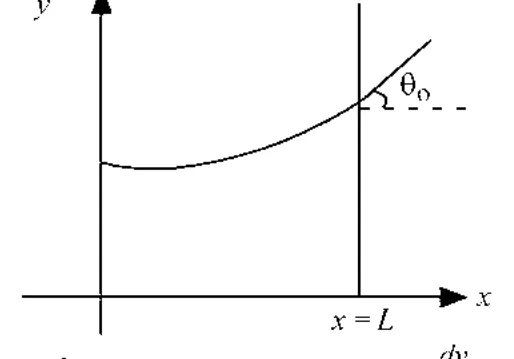
Consider a water tank shown in the figure. It has one wall at x = L and can be taken to be very wide in the z direction. When filled with a liquid of surface tension S and density ρ, the liquid surface makes angle θ_0(θ_0 1) with the x-axis at x = L.…
Consider a water tank shown in the figure. It has one wall at \(x = L\) and can be taken to be very wide in the \(z\) direction. When filled with a liquid of surface tension \(S\) and density \(\rho\), the liquid surface makes angle \(\theta_0(\theta_0 \ll 1)\) with the \(x\)-axis at \(x = L\). If \(y(x)\) is the height of the surface then the equation for \(y(x)\) is :
(take \(\theta(x) = \sin\theta(x) = \tan\theta(x) = \frac{dy}{dx}\), \(g\) is the acceleration due to gravity)
1. \(\frac{d^2y}{dx^2}=\frac{\rho g}{S}x\)
2. \(\frac{d^2y}{dx^2}=\frac{\rho g}{S}y\)
3. \(\frac{d^2y}{dx^2}=\sqrt{\frac{\rho g}{S}}\)
4. \(\frac{dy}{dx}=\sqrt{\frac{\rho g}{S}}x\)